COVID-19 UPDATE


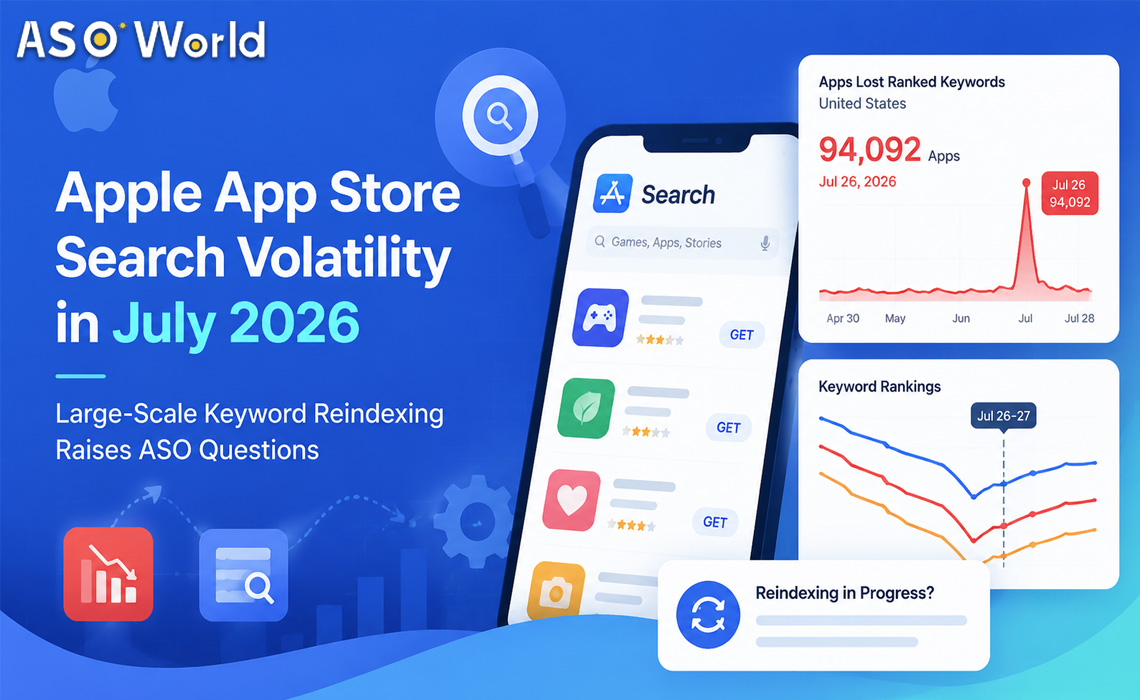
Apple’s App Store search ecosystem appears to have experienced significant volatility around 26–27 July 2026. ASO practitioners across multiple regions have reported widespread keyword ranking fluctuations, sudden keyword disappearances and unexpected visibility swings affecting thousands of applications within a very short window.
While Apple has not officially confirmed any search algorithm update, early data collected from third-party ASO monitoring platforms suggests that the App Store may have undergone a large-scale search relevance recalibration or keyword reindexing process.
1. What the Data Shows
According to observations shared across the ASO community, a substantial number of apps began losing ranked keywords starting on 26 July. Data monitored through ASO platforms revealed a sharp, atypical spike in apps experiencing keyword drops during this window.
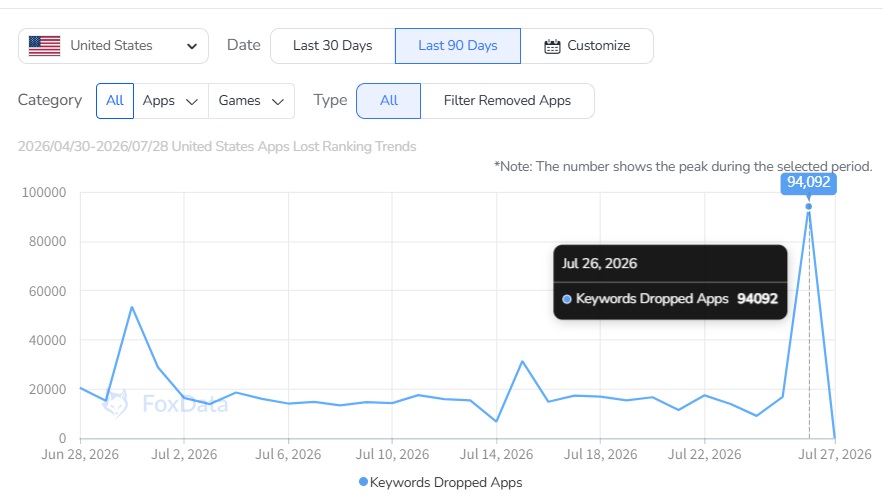
Figure 1 · Number of U.S. apps that lost ranked keywords per day (30 Apr – 28 Jul 2026). The peak on 26 July reached 94,092 apps — an outlier well above the 90-day baseline.
Unlike routine ranking fluctuations, where keywords typically drift up or down gradually, many apps experienced what ASO professionals describe as keyword clearing or deindexing:
- Previously ranked keywords suddenly became “Not Ranked”
- Total keyword visibility dropped sharply
- Long-tail keyword footprints disappeared
- Apps lost rankings without any recent metadata changes
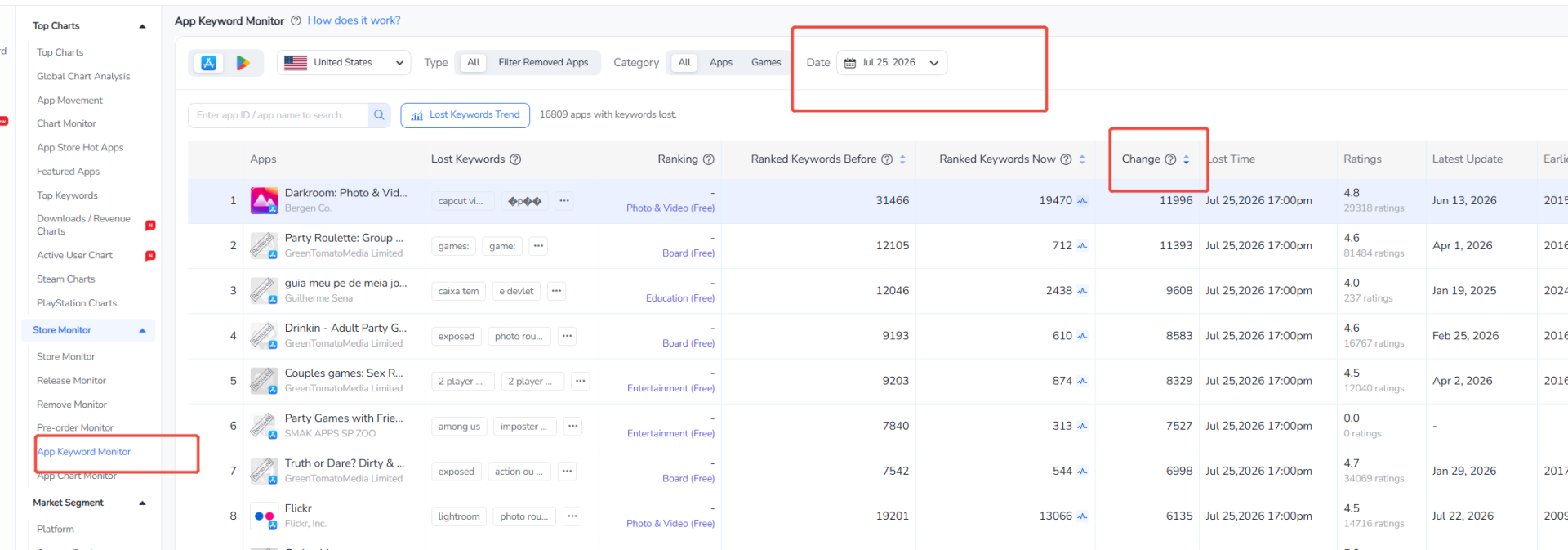
Figure 2 · Snapshot from the App Keyword Monitor. On a single day, over 16,000 U.S. apps registered keyword losses, with the top-affected apps each losing thousands of ranked terms.
2. Algorithm Update or Search Index Recalculation?
The central question among ASO practitioners is whether this event represents a traditional ranking algorithm update, or a large-scale indexing refresh in which Apple redefined what counts as a relevant keyword for each app.
Historically, App Store keyword indexing has relied heavily on the app title, subtitle, keyword field and category relevance. Modern app-search systems, however, increasingly incorporate more complex signals — including user engagement behaviour, conversion performance, search intent matching, quality indicators and semantic relationships between queries and app functionality. A recalibration of these signals could plausibly explain why some apps lost keywords while others gained visibility.
3. Not All Apps Lost Visibility — Some Gained
Notably, the observed changes were not uniformly negative. While many applications lost coverage, a subset saw their keyword footprint expand after 26 July.
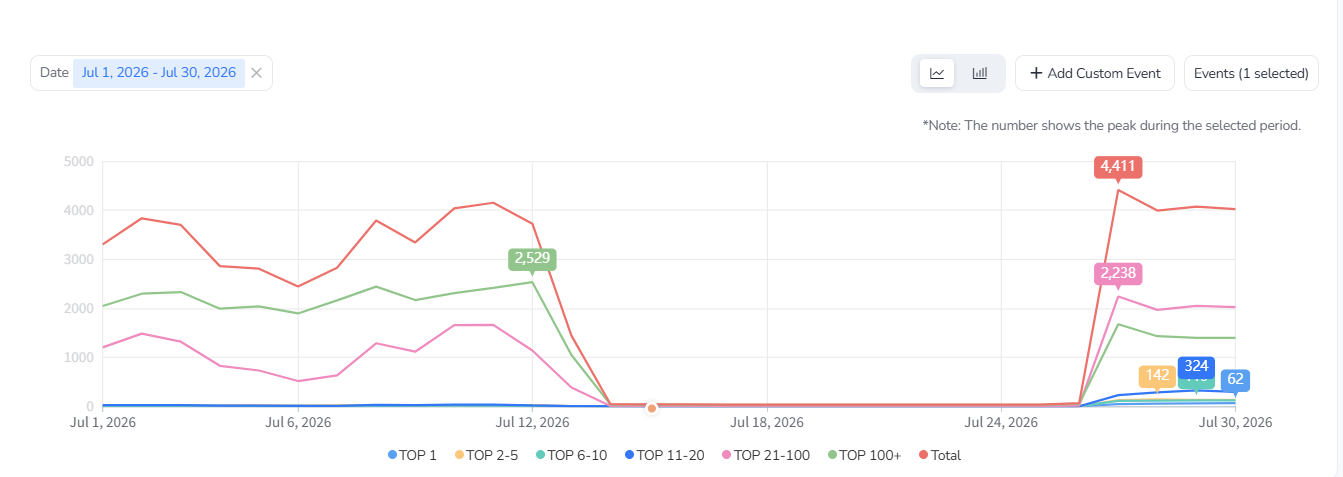
Figure 3 · Example of an app that experienced a sharp collapse across all ranking tiers around mid-July, followed by partial recovery in late July — illustrating how volatile the reindexing period has been.
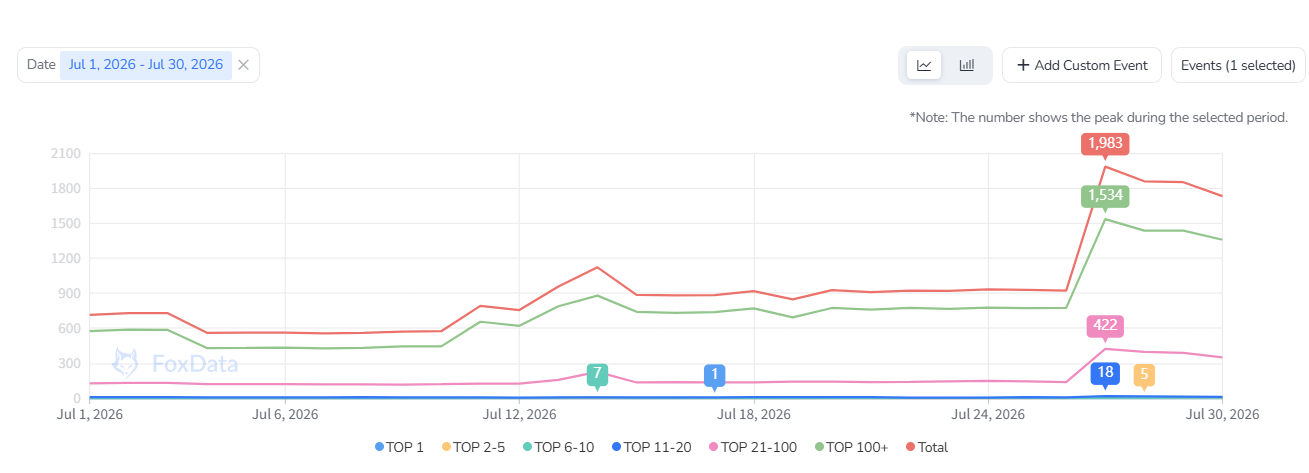
Figure 4 · Example of an app that gained ranked keywords during the same window, suggesting a redistribution of relevance rather than a system-wide contraction.
This pattern suggests the system did not simply reduce indexing coverage across the board. Instead, keyword relevance may have been redistributed based on updated evaluation criteria — a shift from broad keyword matching towards more precise search-intent understanding.
4. Emerging Hypotheses
4.1 Semantic and Intent-Based Relevance
One possibility is that the App Store has moved further towards semantic matching, evaluating whether an app truly satisfies the intent behind a query rather than merely containing the query term. Under such a model, apps with strong intent-alignment would retain or gain visibility, while apps ranking on loosely related terms would lose them.
4.2 Greater Weight on Freshness Signals
Some early observations suggest that newly launched or recently updated apps may be achieving higher search positions than before. If confirmed, this could indicate that launch momentum, recent update activity and early conversion performance are being weighted more heavily. Again, this remains an inference from limited data, not a confirmed change.
4.3 Broader Quality and Engagement Signals
The redistribution pattern is also consistent with a system that places more weight on user engagement, retention and conversion — signals that would naturally favour apps with strong post-install performance over those relying primarily on metadata coverage.
5. Potential Implications for ASO Strategy
If the recalibration observed on 26–27 July becomes a persistent characteristic of App Store search, several strategic implications deserve consideration. These recommendations are precautionary and analytical in nature, not prescriptions based on confirmed platform behaviour.
5.1 Keyword Coverage Alone May Matter Less
For years, many ASO strategies focused on maximising raw keyword coverage. Broader indexing may no longer guarantee visibility. Future optimisation may benefit from prioritising:
- Highly relevant keywords aligned with real user intent
- Stronger conversion performance on target queries
- Owning fewer but more valuable search terms
5.2 Launch and Post-Launch Windows May Become More Critical
If freshness signals are being weighted more heavily, the first weeks after launch — and after major updates — may carry increased strategic importance. Comprehensive pre-launch keyword research, optimised title and subtitle, localised metadata, strong creatives and coordinated early user acquisition all become higher-leverage activities.
5.3 Major Updates as Re-ranking Opportunities
Aligning significant releases with metadata refinements, creative updates and localisation expansion may allow apps to benefit from any freshness-related evaluation windows the system applies.
6. Recommended Actions for App Marketers
Because no official confirmation has been issued, we advise against aggressive, immediate metadata overhauls. Instead, a measured, evidence-based approach is more appropriate:
- Monitor recovery trends. Track lost keywords, newly gained keywords and recovery speed over the next several weeks. Some apps may recover naturally as the system stabilises.
- Segment the affected keywords. Determine whether losses concentrate around keyword-field terms, subtitle terms, generic queries, competitor-related terms or long-tail searches. This helps distinguish an indexing change from a ranking-weight change.
- Avoid over-editing metadata. Frequent changes during periods of algorithmic uncertainty make it harder to isolate cause and effect. Collect data first, identify patterns, then adjust based on evidence.
- Reinforce conversion fundamentals. Regardless of the underlying change, strong screenshots, ratings and post-install performance remain durable ASO foundations.
7. Conclusion: A Possible New Phase for App Store Search
The July 2026 volatility stands out as one of the most notable ASO events of the year. Although no official algorithm update has been announced, evidence from monitoring platforms and community discussion points towards a possible large-scale reindexing or search relevance adjustment.
The most important takeaway for app marketers is that App Store optimisation may continue moving away from simple keyword matching and towards a more intelligent search system driven by semantic relevance, user intent, conversion quality, freshness signals and overall user experience. As the platform continues to integrate more advanced technologies into its ecosystem, ASO strategy will likely need to evolve from pure keyword optimisation towards broader search experience optimisation.
The coming weeks will be decisive in determining whether this event was a temporary recalculation or the start of a more sustained transformation in App Store search. ASOWorld will continue to track the situation and share updates as new data becomes available.