COVID-19 UPDATE


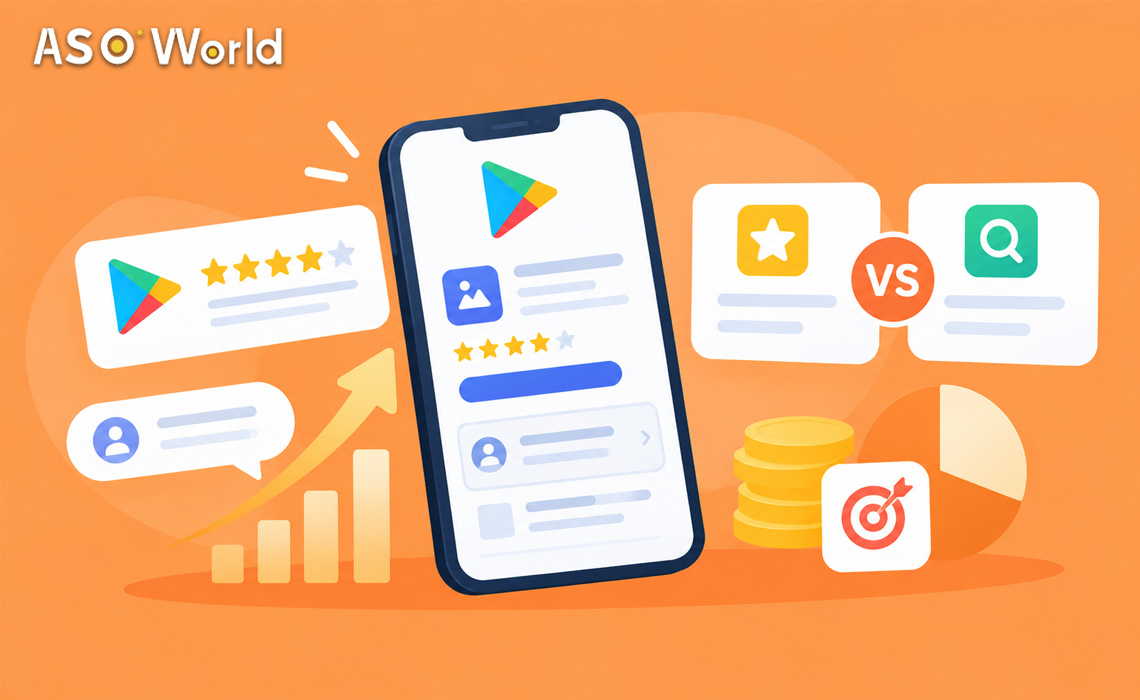
Reviews and keyword installs address two distinct problems — reviews influence conversion once a user has already reached your listing, while keyword installs influence whether they reach it at all. If you can only fund one at present, visibility should almost always come first, because reviews without traffic have nothing to convert, and reviews purchased purely for volume carry genuine retention and compliance risk on both stores. The more sustainable path is to establish ranking first and allow genuine, organic users to generate reviews naturally.
What reviews and keyword installs actually do
| Ratings & Reviews | Keyword Installs | |
|---|---|---|
| Primary function | Improve conversion rate once a user lands on your listing | Improve keyword ranking so users find your listing in search |
| What it fixes | Low download rate despite decent impressions | Low impressions / low search visibility |
| Where value shows up | App Store / Google Play listing page | Search results position |
| Retention over time | Variable — see risk section below | Depends on continued volume, same as any ranking factor |
The practical question to ask first: is your problem that people see your app and do not download it, or that people are not seeing it at all? Most early-stage apps with low traffic fall into the second category, which makes reviews the wrong first lever regardless of budget.
The retention and risk reality of review services
This point is worth stating plainly, because it alters the budget decision. Review and rating services carry meaningfully different risk profiles depending on the store:
- App Store side: Review retention is inconsistent, and accounts employing aggressive review-boosting tactics face genuine policy risk — some developers have reported warning notices linked to unusual review patterns.
- Google Play side: Review retention on non-organic reviews is typically very low; a substantial share is filtered or removed over time, independent of any specific vendor.
Neither of these facts renders reviews worthless as a service — but they do mean that budgeting for reviews as your first and only lever, expecting them to hold long-term without organic traffic behind them, is usually the wrong wager. We examine retention mechanics in greater depth in Why Do Google Play Delete Your App Reviews? and How To Make Your App's Reviews Stay Permanently.
The more durable pattern we observe across accounts: establish keyword ranking first to attract real search traffic, then allow a proportion of those genuine users to leave reviews organically. Reviews generated in this way do not face the same removal risk because they are tied to real usage, not a bulk order.
A sequencing framework for limited budgets
- Step 1 — Fix visibility first. If your app has thin keyword coverage or is not ranking for its core terms, put the first budget cycle into Keyword Installs, configured on the two to three keywords that matter most rather than spread thinly.
- Step 2 — Let organic traffic accumulate for one full cycle. iOS: at least three days; Google Play: seven to nine days. This is also roughly the point at which you will have enough new organic users to begin seeing a handful of unprompted reviews.
- Step 3 — Check your listing’s conversion rate, not just its ranking. If ranking has improved but downloads still lag, that is the moment when reviews and rating become the correct next lever — not before.
- Step 4 — If review volume genuinely needs a boost at that point, treat it as a supplement to organic reviews rather than a replacement for them, and weigh the retention trade-offs above against your specific goal (a launch-week rating threshold versus long-term rating stability are different goals with different risk tolerances).
When it makes sense to run both together
If budget allows for both, they are not competing spends — they are sequential ones that compound. Ranking brings the traffic; a healthy rating and review count improves what percentage of that traffic converts. Apps with reasonable budget typically run a keyword campaign as the base layer and layer a lighter review/rating package on top once ranking has started moving, rather than starting both from zero on day one.
Note also that rating perception is not uniform globally — a 4.2 in one country can look different from a 4.2 elsewhere because of how each store localises rating display. See Why Does Your App's Rating Look Different in Every Country? before assuming a review push needs to be global from day one.
FAQ
If I only have budget for one thing this month, which should it be?
For most apps, keyword installs. Reviews improve conversion, but conversion only matters once people are actually finding your listing. If your keyword coverage and ranking are already solid and downloads still lag behind impressions, that is the exception — start with reviews instead.
Do reviews help my keyword ranking directly?
Ratings and reviews are one signal among many in both stores’ ranking systems, but they are a secondary signal — install velocity and search-relevant metadata carry more direct weight on keyword position. Treat reviews as a conversion lever first, ranking lever second.
Is it risky to buy reviews at all?
It carries more platform risk than keyword installs do, and retention varies significantly by store, as covered above. If you go this route, treat it as a supplement to organically earned reviews rather than your primary review strategy, and avoid short, aggressive bursts.
How quickly will reviews from real organic traffic start showing up after a keyword campaign?
There is no fixed number — it depends on your app’s category and typical user behaviour — but once ranking has held for a full cycle and organic downloads are flowing in, most apps start seeing a trickle of unprompted reviews within the following one to two weeks.