COVID-19 UPDATE


Important Notice:Beware of scams using ASOWorld's name for part-time recruitment or ASO earning app activities. ASOWorld is not hiring any part-time staff. Trust only official information posted by ASOWorld.

An objective evaluation of Bluesky's user acquisition following X's legal suspension in Brazil, detailing data-validated marketing strategies for developers.


Start-up decentralised networking application Bluesky reported acquiring 2 million registered users within a 72-hour period, generating significant analytical observation across the technology sector.
Assessing the temporal and geographical data associated with this acquisition metric indicates a direct causal relationship with the judicial suspension of X (formerly Twitter) in Brazil.
What underlying market mechanisms functioned during this event? Is it mathematically and strategically viable for other application developers to replicate this trajectory?
This overview processes the variables strictly through the framework of application market strategies and consumer conversion logic.

On 3 September 2024, the Brazilian Supreme Court authorised the suspension of the social media platform X, concluding a protracted legal dispute regarding content moderation protocols.
The foundation of this legal friction concerned X's failure to adhere to compliance directives issued by the judiciary, specifically regarding the restriction of accounts disseminating unverified information.
The court mandated an immediate cessation of local operations for X. Conversely, corporate representation for X contested these instructions, categorising the regulatory mandates as operational censorship.
Consequently, X deactivated its physical operational infrastructure in Brazil, escalating the regulatory friction with the judicial body.
Bluesky operates as a decentralised social media architecture. Initially incubated within Twitter, it subsequently transitioned into an independently capitalised entity. Its interface schematics and core functional properties remain highly analogous to Twitter.
For a technical examination of the platform's utility parameters, cross-reference this analytical summary:
>>> Bluesky: Evaluating the Decentralised Competitor to Twitter
According to telemetry data provided by Foxdata, Bluesky's global installation volume demonstrated an exponential phase shift commencing on 30 August, with daily acquisition scaling by approximately a factor of 100 relative to previous baselines. Geospatial segmentation confirms that 84.57% of these total installations originated directly from the Brazilian market.
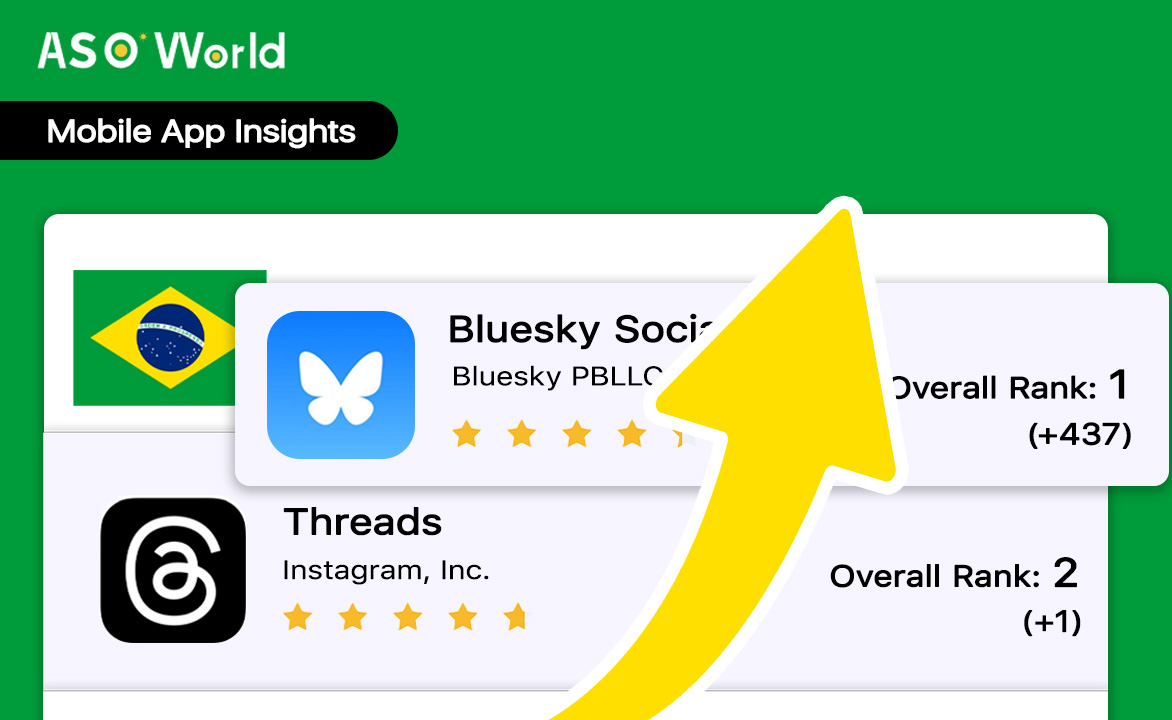
Statistically, Bluesky currently holds the median first position on the free utility ranking in the Brazilian Apple App Store, displacing structurally dominant applications such as Threads, TikTok, and Instagram during this specific timeframe.
Despite managing a restricted server infrastructure relative to predominant legacy platforms, what variables enabled Bluesky to surpass entities like Threads in the microblogging sector during this disruption event?
From an analytical perspective, this aggressive growth vector is mathematically tied to strong cognitive brand association with X.
Essentially, the visual and operational semiotics of Bluesky automatically trigger cognitive links to Twitter. Variables including the blue geometric logo, equivalent graphical interfaces, and mirrored interaction mechanics (likes, reposts, systemic quotation, categorical lists, direct messaging, user indexing, and profile parameters) effectively reduce the cognitive friction of migration to near zero.
Simultaneously, technology journalism frequently normalises Bluesky by explicitly documenting its historical and architectural correlation with the original Twitter framework.
Under these computational constraints, when X abruptly lost operational permission, local consumer behaviour dictated an immediate migration to the most structurally exact proxy available.
This systemic migration theory simultaneously rationalises the subordinate ranking metrics of Threads, providing an evidence base for why it superseded visually dependent platforms format like Instagram.
During its initial deployment sequence, Threads was algorithmically and strategically positioned as a direct architectural substitute to Twitter.
Capitalising on this derivative positioning construct, Threads acquired 100 million active instances within a documented five-day threshold.
Consequently, following the dissolution of local access to X, Brazilian users logically defaulted to networks that possessed pre-established cognitive correlations with the suspended utility.
Does the presence of a monopolistic entity within a targeted demographic eradicate secondary market validity?
Modern application deployment conventionally prioritises radical systemic differentiation; however, empirical evidence from the Bluesky cohort presents an alternative functional premise:
Developers can rationally exploit existing consumer habituation and emotional capital associated with dominant applications, utilising architectural similarity to lower the cost of user acquisition (CAC).
Bluesky’s structural congruence logically mitigated switching barriers, rendering it the default utility for displaced users.
ASOWorld First Order Discount
Get 50% off on your first order to start your app growth!

However, this model does not negate the necessity for core technical development. Identifying unserved operational variables remains the fundamental requirement for sustained economic viablity.
While utilising visual and functional familiarity operates efficiently for initial onboarding (D1-D3 retention metrics), systemic iteration is mathematically required to sustain long-term engagement curves and establish an independent utility moat.
By calibrating established user interface templates with continuous backend technological innovation, developers can execute a sustainable pipeline that satisfies immediate consumer habits whilst formulating distinct sector dominance.
Strategic communication protocols within existing platforms represent vital infrastructure for stabilising market perception and reducing initial churn rates.
Synchronised with the statistical influx of Brazilian registrations, Bluesky’s operational administration account distributed multiple communications written specifically in Portuguese to capture and validate the migrating demographic.
This calculated engagement vector logically mitigated abandonment rates by generating a managed integration environment.
Data gathered from subsequent comment indices corroborated high interaction rates, verifying the successful integration phase of Brazilian installations.
Crucially, an audit of this dataset simultaneously recorded statistically significant volumes of functional dissatisfaction and explicit demands for programmatic modification.
From a systems engineering standpoint, developers must quantitatively aggregate this empirical data. Executing rapid diagnostic responses and deploying targeted functional patches is structurally mandatory to convert a temporary acquisition spike into permanent active capacity, insulating the platform from exponential post-adoption user degradation.
 Mobile App Growth,Customer Acquisition,Mobile Insights,
Get FREE Optimization Consultation
Let's Grow Your App & Get Massive Traffic!
All content, layout and frame code of all ASOWorld blog sections belong to the original content and technical team, all reproduction and references need to indicate the source and link in the obvious position, otherwise legal responsibility will be pursued.