COVID-19 UPDATE


Important Notice:Beware of scams using ASOWorld's name for part-time recruitment or ASO earning app activities. ASOWorld is not hiring any part-time staff. Trust only official information posted by ASOWorld.

How is AI reshaping app category rankings in 2026–2027? Learn how supply shock, AI-powered curation and zero-click discovery are rewriting ranking rules — plus a five-step optimisation framework.


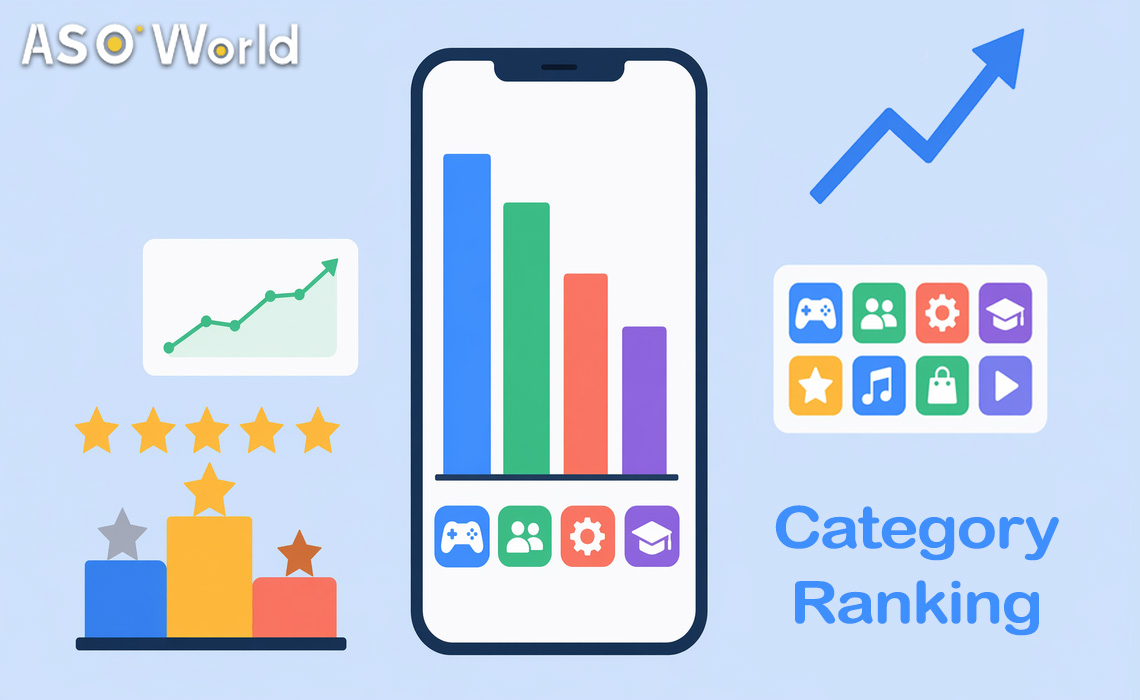
If your app's position on the category charts has been fluctuating more than usual lately, you are not imagining things. Two parallel forces are transforming app category ranking mechanics in ways we have not seen before: an explosive supply shock from AI-assisted development (global app releases are up roughly 60% year-over-year in early 2026), and platform-side AI curation that is replacing traditional search-and-browse behaviour with personalised, intent-driven discovery.
In this guide, we break down the emerging trends reshaping app category rankings in 2026–2027, explain how AI-powered app store curation is rewriting the rules, examine what this means for traditional ASO practices, and share actionable strategies you can apply right now to protect and grow your position.
The single biggest structural change in 2026 is sheer volume. AI coding tools have dramatically lowered the barrier to shipping apps, enabling non-developers and small teams to build and publish at unprecedented speed. The result: category charts are more volatile and short-lived than ever. Velocity spikes matter more than sustained install volume, and competition has intensified not just in top categories but across the mid and long tail.
This supply shock is also reshuffling which categories dominate. While games still lead in absolute volume, Utilities have climbed to #2, Lifestyle to #3, and Productivity plus Health & Fitness are entering the top five. AI-native use cases — tools, assistants and automation apps — are pulling rankings away from pure entertainment. "Micro-utility apps" (single-purpose tools) are rising faster than large platforms, and in some markets, four of the top six free apps are AI-related.
One telling example: an AI video generator app reached the top five for high-competition keywords by combining strategic category positioning with a tiered keyword approach — a playbook that illustrates how newer entrants can break through even in crowded AI-dominated charts.
A new "meta-category" is effectively emerging: AI apps that compete across productivity, education and utilities simultaneously, blurring traditional category boundaries. For marketers, this means category ranking is no longer siloed — your competitive set may include apps from entirely different categories that serve overlapping user needs.
Historically, app category ranking was largely a numbers game: more installs pushed you higher on the chart. That model is fading fast. In 2026, both Apple's App Store and Google Play weight behavioural engagement signals — including retention rate, session frequency and user-perceived quality — alongside download velocity.
Apple's own data confirms that search accounts for roughly 65% of all App Store downloads, and the algorithm now evaluates whether users who find your app actually stay. Google Play has gone further, tying technical quality metrics (crash rates, ANR thresholds) directly to store visibility. Apps exceeding Google's "bad behaviour" benchmarks — such as a 0.47% daily ANR rate — see reduced discoverability and may trigger user-facing warnings on the listing page.
What this means for category ranking: an app with moderate download numbers but strong 7-day retention and low crash rates can now outrank a competitor with higher installs but poor engagement. If you are still measuring success purely by install count, your ASO strategy needs a fundamental update.
The traditional "Top Free" and "Top Paid" lists are no longer the primary discovery surface. Both platforms have invested heavily in AI-curated recommendations that personalise what each user sees based on their behaviour, preferences and context.
On the Apple App Store, the Today tab and curated collections use engagement and quality signals to surface smaller apps alongside major titles. Apple's new App Store Tags feature auto-generates labels from your metadata using AI, which can influence browse placement in ways that static category ranking never could. In-app events — tournaments, seasonal promotions and content drops — are now indexed and can appear directly in search results, expanding your discoverability footprint beyond the standard product page.
On Google Play, the shift is even more pronounced. The Engage SDK, Collections and the You tab all reward apps that keep users coming back, not just those that acquire them. Google's Guided Search uses AI to organise results by user intent: when someone types "find a home" instead of specific keywords, the algorithm sorts relevant apps into contextual categories. This fundamentally changes how apps surface within and across category boundaries.
With AI-driven Guided Search on Google Play, your app can surface for goal-based queries even outside your primary category. Ensure your long description includes natural-language phrases that match how real users describe their problems — e.g. "track my daily water intake" rather than just "health tracker". This intent-based optimisation is a growth lever most competitors overlook.
Choosing the right category used to be a one-time decision made at launch. In 2026–2027, it has become an ongoing competitive strategy. With AI curation blurring the lines between categories, your primary and secondary category choices directly affect which algorithmic buckets your app competes in — and which personalised recommendation feeds it appears on.
A common mistake is defaulting to the most obvious category. A meditation app filed under "Health & Fitness" competes against thousands of workout trackers, while filing under "Lifestyle" may place it in a less crowded field with equally relevant user intent. The data consistently shows that apps choosing strategically aligned but less saturated categories achieve higher chart positions and better organic conversion rates.
Apple and Google also treat category signals differently. On iOS, the primary category contributes to keyword relevance and directly affects where your app appears in browse results. On Google Play, your category influences which competitor set the algorithm benchmarks you against. Understanding these nuances is critical for choosing effective categories that maximise your ranking potential.
One of the most consequential developments of 2025 — carrying significant momentum into 2026 and 2027 — is that Apple's Custom Product Pages (CPPs) now appear in organic search results, not just paid campaigns. With the limit doubled to 70 CPPs per app, developers can create intent-matched store listing variants that surface automatically when users search for specific terms.
For app category ranking, this means a single app can effectively occupy multiple positions within a category by presenting different value propositions to different audience segments. A project management app, for example, can show freelancer-focused screenshots for "freelance time tracker" searches and team-focused visuals for "team collaboration tool" queries — all within the same Productivity category listing.
Google's Custom Store Listings (CSLs) offer similar segmentation. Early data shows a median 10% conversion lift when CSLs are utilised strategically. Combined with the Engage SDK's ability to surface personalised content across Play surfaces, the personalisation toolkit on Android has expanded considerably.
Apple's algorithm update in mid-2025 confirmed that screenshot caption text is now actively indexed for search ranking. This transforms screenshots from a pure conversion element into a dual-purpose asset that affects both your keyword ranking and your category chart position.
If your screenshot captions currently say things like "All-in-One Solution" or "Best App Ever", you are wasting valuable metadata real estate. Captions like "Track Your Run in Real Time" or "Edit 4K Video with One Tap" perform better for both algorithms and human decision-making.
Apple's 2024 Transparency Report revealed a striking data point: the App Store averaged 1.9bn re-downloads per week versus 839 million new downloads. Re-downloads now outpace first-time installs by more than 2:1. This signals a fundamental shift in how the stores value user lifecycle — and it directly affects category ranking calculations.
Apps that generate high re-engagement rates signal quality to the algorithm. Google has made this explicit through the Level Up programme for games, which grants enhanced store visibility to titles meeting engagement benchmarks around player continuity, cross-device support and session depth.
For your category ranking strategy, this means retention optimisation is no longer a "post-launch" concern — it is a ranking factor. Invest in onboarding flows that drive first-session value, use in-app events to re-engage churned users, and treat your app store listing as an ongoing marketing channel, not a static page.
Google Play now uses AI to generate automatic review summaries that highlight recurring pros and cons at the top of your listing. Users increasingly skip individual reviews entirely and base their install decision on these AI-curated sentiment snapshots.
The implication for category ranking is twofold: first, conversion rate from listing view to install is becoming a stronger ranking signal; second, the themes and sentiment clusters in your reviews now matter more than individual star counts. A recurring complaint about crashes or confusing onboarding — even from a small number of reviews — can be surfaced prominently by the AI summary and tank your conversion rate. Managing review themes has become as important as maintaining a high average rating. Understanding how to improve your app ratings and reviews strategically is now a core category ranking discipline.
Perhaps the most forward-looking trend: users are increasingly discovering apps through AI assistants — ChatGPT, Siri and Google Gemini — rather than browsing app store category charts. The flow looks like this: user asks the AI for a recommendation → AI suggests specific apps → user taps a deep link to install, bypassing the store's search and browse experience entirely.
In this model, the App Store becomes infrastructure rather than the primary discovery channel. Your app's web presence, review sentiment and structured metadata determine whether AI recommends you — not your position on a category chart. This does not make category ranking irrelevant, but it does mean that developers relying solely on chart position for organic growth are building on an increasingly narrow foundation.
These shifts do not make traditional ASO obsolete — but they do redefine what each lever actually accomplishes. Here is how the core ASO components are evolving, and what practitioners should adjust.
Keywords remain the foundation for initial app store indexing and baseline relevance. Without keyword coverage, your app simply will not surface for relevant searches. But keywords alone no longer drive sustained category ranking. The stores' AI layers now perform semantic matching — evaluating whether your app's overall metadata, reviews and behavioural data actually align with user intent, not just whether you have placed the right words in the right fields.
The practical shift: keyword-driven organic traffic growth remains a proven approach for establishing and defending search positions — especially for new apps that need to build initial indexing signals. Services like targeted keyword installs help apps build the search-specific download signals that algorithms use for initial indexing, creating the foundation on which semantic relevance can then compound. But keyword installs work best when paired with strong post-install engagement that validates the keyword relevance algorithmically.
A clear pattern is emerging in how category rankings behave in 2026:
This two-phase model means growth teams need to plan for both stages. A structured approach that combines the right mix of keyword installs and package installs for the launch spike — followed by retention and review optimisation for the quality-filter phase — produces more durable ranking results than either approach alone.
The discipline is expanding beyond metadata and keywords to encompass the entire app experience as a ranking input. AEO — App Experience Optimisation — captures this shift. It means your onboarding quality, session frequency, feature clarity and even your app's technical performance are now part of your "optimisation surface." Teams that integrate product, engineering and marketing under a unified AEO framework will consistently outperform those still siloing ASO as a marketing-only function.
Think of it this way: traditional ASO gets your app found. AEO gets your app selected by the AI systems that increasingly decide what users see.
With AI-generated review summaries now prominent on Google Play, and review sentiment influencing both conversion rates and algorithmic quality assessments, your review profile is no longer just social proof — it is a machine-readable ranking signal. A healthy, growing review base with consistent positive sentiment themes directly supports category ranking stability.
For apps building momentum or recovering from a negative review cycle, a structured review and rating improvement programme accelerates the quality-filter phase. The key is consistency: a steady stream of authentic positive reviews carries more algorithmic weight than sporadic bursts. Our analysis of how app reviews affect business metrics like LTV and CPI illustrates why review management belongs in the growth team's core toolkit, not as an afterthought.
In a market flooded with AI-generated apps, update frequency itself has become a ranking signal. Both platforms favour apps that ship improvements regularly — it signals active maintenance, ongoing quality investment and responsiveness to user feedback. Faster iteration cycles (themselves enabled by AI-assisted development) improve ranking signals and help you adapt to algorithm changes before competitors who update quarterly.
For teams looking at practical examples of how integrated ASO execution drives measurable results, the social app case study achieving +140% installs through organic search optimisation demonstrates the kind of compounding growth that systematic keyword and ranking work can deliver.
Knowing what has changed is only useful if you know how to respond. Here is a practical framework you can apply immediately.
Step 1: Audit your category fit. Review whether your primary and secondary categories still represent the best competitive environment. Use competitor analysis to identify categories where your app's engagement metrics would place you in the top quartile rather than fighting for the bottom of a saturated chart. If you are unsure where to start, our guide on Google Play Store ASO and keyword optimisation covers the mechanics of how category signals interact with keyword relevance.
Step 2: Build a keyword-to-CPP mapping. Identify your top 15–20 keywords and assign them to specific Custom Product Pages (iOS) or Custom Store Listings (Android). Each variant should feature screenshots, captions and promotional text tailored to the intent behind that keyword cluster. This creates multiple entry points into your category listing.
Step 3: Optimise for technical quality signals. On Google Play, connect your Play Console crash and ANR data to your ranking performance. If you see a category ranking drop, check whether a recent build pushed your stability metrics above the bad behaviour threshold before assuming it is a keyword or creative issue. On iOS, monitor app size relative to category norms and first-session crash-free rates.
Step 4: Implement a review velocity programme. Ratings and reviews remain a confirmed ranking factor on both platforms. Apps with fewer than 3.5 stars see noticeably lower visibility, while those above 4.0 gain meaningful ranking lift. A structured approach to building your app store review profile can accelerate your category ranking gains.
Step 5: Treat ASO as a continuous programme. The apps that maintain top category positions review and update their metadata quarterly. Algorithm weights shift, competitor behaviour changes and seasonal search trends evolve. Developers who refine their keyword selection strategy on an ongoing basis consistently outperform those who set it and forget it. For teams that need to hit specific ranking targets on a defined timeline, a guaranteed keyword ranking service can provide the concentrated push needed to break into the top positions — after which the quality-filter phase determines whether you hold that ground.
Looking further ahead, the structural shift continues to accelerate:
For developers and marketers just beginning to formalise their approach, our ASO plan for app promotion beginners provides the foundational framework you need before tackling these advanced category ranking strategies.
Category ranking shifts often correlate with broader market movements. Staying current with the latest app store trends and ASO insights helps you distinguish between algorithm changes, seasonal patterns and competitor movements — so you invest optimisation effort where it will actually move the needle.
2026–2027 marks a structural shift in app category ranking. Rankings are no longer static charts — they are dynamic, AI-shaped outputs. ASO is no longer about "ranking higher" in isolation — it is about being selected by the AI systems that increasingly decide what users see.
The competitive edge is moving from keywords to context, from installs to retention and from charts to personalisation. For developers who invest in quality engagement signals, intent-matched store listings and disciplined optimisation practices, AI-powered curation is an equaliser — one that gives well-optimised apps a real chance to compete against entrenched incumbents.
The teams that treat app category ranking as an ongoing, data-driven discipline — combining launch-phase velocity with sustained quality signals — will be the ones who capture the outsized organic growth these platform shifts are designed to reward.
App category ranking in 2026 is determined by a combination of download velocity, user engagement signals (retention, session depth, re-downloads), ratings and reviews, technical quality metrics (crash rates, ANR rates) and metadata relevance. Both Apple and Google have shifted towards weighting engagement quality over raw install numbers, meaning apps with strong post-install behaviour outrank those with high downloads but poor retention.
AI-powered curation personalises what each user sees in the app stores, meaning there is no single "universal" category chart anymore. Both platforms use machine learning to blend editorial picks with algorithmic recommendations based on user behaviour. Your app may rank differently for different user segments. Optimising for engagement signals, using Custom Product Pages and maintaining strong technical quality are the primary ways to influence AI-curated placements.
Potentially, yes. If your app is stuck in the bottom half of a highly saturated category, switching to a less competitive but equally relevant category can yield immediate ranking improvements. However, category changes should be data-driven — analyse the competitive density, average ratings and engagement benchmarks in your target category before making the switch. Test with your secondary category first if possible.
At minimum, review and update your metadata, screenshots and keyword targeting quarterly. Algorithm weights shift, competitor behaviour changes and seasonal search trends evolve continuously. Top-performing apps on Google Play A/B test their screenshots at least twice per year. Combine scheduled optimisations with reactive updates whenever you detect significant ranking shifts in your tracking data.
Zero-click discovery refers to the emerging pattern where users find and install apps through AI assistants (ChatGPT, Siri, Google Gemini) without ever browsing app store category charts. The AI suggests specific apps and provides deep links to install directly. This does not make category ranking irrelevant — it still drives substantial organic traffic — but it means developers must also optimise for AI-readable signals: structured metadata, positive review themes, strong web presence and clear value propositions that AI systems can parse and recommend.
ASO (App Store Optimisation) traditionally focuses on metadata, keywords, screenshots and reviews to improve store visibility and conversion. AEO (App Experience Optimisation) expands this to include the entire user experience as a ranking input — onboarding quality, session frequency, technical performance, retention loops and feature clarity. In 2026–2027, as algorithms weight post-install behaviour more heavily, AEO represents the evolved form of ASO where product quality and marketing optimisation merge into a single discipline.
Get FREE Optimization Consultation
Let's Grow Your App & Get Massive Traffic!
All content, layout and frame code of all ASOWorld blog sections belong to the original content and technical team, all reproduction and references need to indicate the source and link in the obvious position, otherwise legal responsibility will be pursued.