Key Takeaways
- Even apps with millions of downloads and proper age ratings can be removed without warning—proactive compliance is non-negotiable.
- Google Play policy updates happen multiple times per year; subscribing to official channels and performing quarterly audits is the minimum standard.
- Metadata, content ratings, privacy declarations, and in-app content must all align; a mismatch in any single area can trigger removal.
- Use store intelligence tools like FoxData to monitor removal trends and competitive dynamics so you can spot enforcement waves early.
- Always maintain a documented appeal strategy and diversify your distribution channels to reduce single-platform risk.
The Wake-Up Call: Doki Doki Literature Club Pulled from Google Play
On April 8, 2026, Google quietly removed Doki Doki Literature Club (DDLC)—one of the most acclaimed indie visual novels of the past decade—from the Google Play Store. The reason cited? A violation of Google’s Terms of Service related to the game’s “depiction of sensitive themes.”
The numbers make this removal particularly striking. The free version of DDLC had amassed over 30 million downloads across platforms. On Google Play alone, the paid “Plus” version had accumulated over 20,000 user reviews with a near-perfect rating. The listing was properly classified as “Mature 17+”, the game opened with an explicit content warning (“This game is not suitable for children or those who are easily disturbed”), and in-app settings offered additional content warning toggles.
Publisher Serenity Forge immediately pushed back, issuing a public statement defending the game’s handling of mental health themes and announcing efforts to get DDLC reinstated. Notably, the game remains available on iOS, Steam, Nintendo Switch, PlayStation, and Xbox—suggesting either a discrepancy in how platforms interpret similar content guidelines, or an error in Google’s enforcement process.
For app developers and marketing professionals, this incident carries a clear message: no app is too popular, too well-rated, or too compliant-looking to be immune from sudden removal. If a game with 30 million downloads and proper content labeling can be pulled overnight, any app in your portfolio could face the same fate.
This article provides a comprehensive, actionable framework for protecting your app from Google Play removal—whether you’re building a game, a utility, a fintech product, or a content platform. For a broader overview of removal risks, see our detailed guide on how to protect your Android app from Google Play deletion.
The Scale of App Removals: It's Bigger Than You Think
DDLC’s removal is not an isolated case. Google Play enforces policy at massive scale, and the numbers are sobering. To understand the volume, consider data from FoxData, a competitive intelligence platform that tracks real-time release and removal dynamics across app stores.
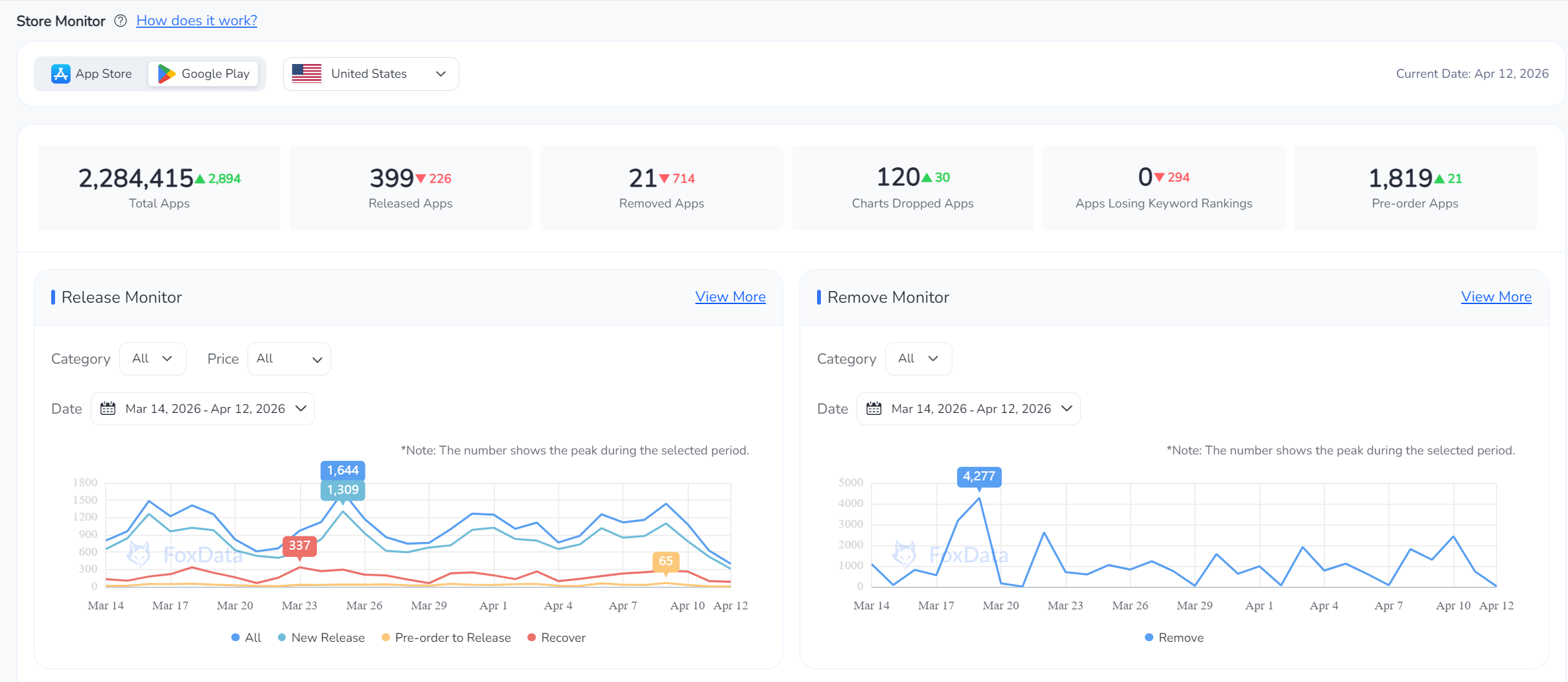
FoxData Store Monitor — US Google Play, Mar 14 – Apr 12, 2026.
Look at the Remove Monitor chart above: during a single enforcement wave around March 17, Google removed over 4,200 apps in one day. Even on quieter days, daily removals routinely range between 500 and 1,500. Over the 30-day window shown, the US Google Play Store saw a net increase of only 2,894 apps despite hundreds of new releases daily—because removals are running at a comparable pace.
These removal surges often coincide with policy enforcement cycles—periods when Google batch-processes compliance reviews following newly announced policy updates. This is precisely why tracking policy timelines is critical. For the latest updates, review our coverage of the March 2026 Google Play policy changes.
Why Google Play Removes Apps: The Core Reasons
Before diving into strategies, it’s essential to understand the categories of violations that trigger removal. Based on Google’s published policies and historical enforcement patterns, the primary reasons include:
Sensitive / Restricted Content
Depictions of violence, self-harm, sexual content, hate speech, or substance abuse that exceed the declared content rating or violate absolute prohibitions.
Privacy & Data Policy Violations
Undisclosed data collection, missing privacy policies, failure to comply with data safety section requirements, or COPPA violations for child-directed content.
Misleading Metadata
Keyword stuffing, fake screenshots, inflated feature claims, impersonation of other brands, or descriptions that don’t match the app’s actual functionality.
Malware, Security & Spam
Malicious code, deceptive ads, apps that crash on launch, duplicate/copycat submissions, or apps that exist solely to redirect users to a website.
Regulatory / Category-Specific
Non-compliance with finance, health, gambling, or VPN-specific requirements. Google has tightened rules in verticals like Health Connect and financial services.
Outdated / Abandoned Apps
Apps targeting outdated API levels, failing to meet new user engagement metrics, or left unmaintained for extended periods.
The DDLC case falls squarely in the first category: sensitive content enforcement. But what makes it noteworthy is that the developer did follow many best practices—age rating, content warnings, contextual handling of themes—and was still removed. This underscores a hard truth: compliance is necessary but may not be sufficient. You need layered defenses.
8 Proven Strategies to Protect Your App from Removal
Below is a comprehensive playbook. Each strategy is something you can implement this quarter.
1. Stay Ahead of Google Play Policy Changes
Google Play updates its policies multiple times per year, with enforcement deadlines that can arrive as quickly as 30 days after announcement. Missing a single update cycle can leave your app non-compliant without your knowledge.
Expert Tip
- Subscribe to the Google Play PolicyBytes newsletter and the Android Developers Blog. These are the first channels where updates appear.
- Set calendar reminders 7 days before every published enforcement deadline. Google's official policy webinars often reveal nuances not captured in written policy documents.
- Maintain a “Policy Change Log” in your team’s project management tool—log every update with the affected areas, deadline, and your app’s remediation status.
- Follow ASOWorld’s policy coverage for interpreted, developer-friendly summaries of changes like the March system updates and March 2026 store changes.
2. Get Content Rating & Age Classification Right
The DDLC case demonstrates that even a “Mature 17+” rating may not be sufficient protection if Google determines the content itself crosses a hard policy line. Content ratings signal who should see the app; they don’t grant blanket permission for all types of content.
Expert Tip
- Complete the IARC questionnaire with granular honesty. When in doubt about a content element, rate it higher, not lower. Under-rating is a common trigger for removal.
- Re-submit the rating questionnaire after every major update that introduces new content, story arcs, or user-generated content features. Your rating from v1.0 may not cover v3.0.
- If your app contains sensitive themes (mental health, substance use, violence), document your content handling approach in both the store listing description and within the app itself. In-app content warnings, toggle-able filters, and “safe mode” options all demonstrate good faith.
- Review Google's child safety policy updates if your app could be accessed by minors—even if it’s not designed for them.
Common Mistake
Assuming that a correct content rating makes you “safe.” Google's policies include absolute prohibitions—certain types of content (e.g., graphic depictions of self-harm, real-money gambling without licenses) are banned regardless of rating. A Mature 17+ tag does not override these hard limits.
3. Ensure Metadata Compliance Across Your Entire Listing
Your app's store listing—title, description, screenshots, icon, and promotional graphics—is subject to its own set of rules. Metadata violations are among the most common reasons for app suspensions, and they're also the easiest to prevent. For a comprehensive guide to metadata best practices, see our guide to maximizing app metadata.
Expert Tip
- Avoid keyword stuffing in your title and description. Google's algorithms are trained to detect unnatural keyword density. Focus on natural language that accurately describes your app’s core value.
- Screenshots must reflect actual in-app experience. Do not use mockups that show features your app doesn't have, performance it can't deliver, or UI elements from a different version. Learn more in our guide on optimizing app store product pages.
- Your icon must comply with current requirements, including the themed icon mandate enforced since late 2025.
- For white-label or multi-instance apps, follow the updated guidelines for white-label developers—each listing must have a unique identity and decentralized account structure.
4. Master Privacy & Data Handling Requirements
Privacy enforcement has become one of Google Play's most aggressive compliance areas. The Data Safety section is not optional decoration—it's a living compliance document that Google actively audits.
Expert Tip
- Audit every SDK in your app for data collection behavior. Third-party analytics, ad networks, and crash reporters often collect data you haven’t declared. Use tools like Exodus Privacy to scan your APK.
- Your Data Safety section must exactly match actual app behavior. If your app collects location data—even for analytics—it must be declared. Discrepancies are a primary removal trigger.
- Implement and link a GDPR/CCPA-compliant privacy policy. The policy must be accessible from both the store listing and within the app.
- If your app integrates Health Connect, review the March 2025 Health Connect policy update for enhanced data-sharing and justification requirements.
5. Handle Sensitive Themes with a Compliance-First Approach
This is the strategy most directly relevant to the DDLC case. If your app deals with mental health, violence, political content, gambling, substances, or other sensitive topics, you need more than good intentions—you need documented, reviewable compliance infrastructure.
Expert Tip
- Implement in-app content warnings and toggles. Give users control over what they see. This demonstrates responsible design and creates documented evidence of good-faith compliance.
- Provide crisis resources. If your app addresses mental health, include links to helplines (988 Suicide & Crisis Lifeline, Crisis Text Line) within the app and in your store listing.
- Create an internal "Sensitive Content Policy" document that maps each content element in your app to the relevant Google Play policy clause. This accelerates any appeal process.
- Test with multiple Google accounts under different parental control configurations to ensure age-gating works correctly and restricted content is properly filtered.
- For user-generated content (UGC) platforms, implement automated moderation and human review processes. Google holds the platform responsible for UGC that violates its policies.
Common Mistake
Relying on "artistic merit" or "educational value" as a defense without building the compliance infrastructure to back it up. Google's automated review systems don't evaluate artistic intent—they flag content patterns. Your compliance story must be machine-readable and human-reviewable.
6. Conduct Regular Self-Audits and Pre-Submission Testing
The most effective way to prevent removal is to catch issues before Google does. Build a compliance audit cycle into your release process. Our App New Version Launch ASO Checklist provides a 30+ step framework for exactly this purpose.
Expert Tip
- Quarterly Compliance Audit: Review your app against the latest Google Play Developer Policy Center at least every 90 days—even if you haven't shipped an update.
- Pre-release policy checklist: Before every submission, verify—content rating accuracy, Data Safety section truthfulness, metadata compliance, API level targeting, and permission justifications.
- Test on Google Play's internal testing tracks first. Use closed testing to validate that your app passes initial automated checks before rolling out to production.
- Monitor your Google Play Console inbox daily. Policy warnings often arrive as non-urgent notifications that are easy to miss—but they have hard deadlines.
7. Build a Reinstatement & Appeal Strategy Before You Need One
Hope for the best, plan for the worst. Having an appeal playbook ready before a removal event can compress your response time from weeks to days.
Expert Tip
- Document everything proactively. Maintain a compliance folder with: your content rating questionnaire responses, Data Safety section records, content moderation logs, and a version history of policy-relevant changes.
- Draft a template appeal letter that includes: your app's compliance measures, content justification, user safety features, and a specific remediation plan. When removal hits, you'll fill in specifics rather than starting from scratch.
- Know the appeals process. Google's appeals are submitted through the Play Console. You typically get one appeal per removal event. Make it count—be specific, reference exact policy clauses, and offer concrete changes.
- Maintain a relationship with Google Developer support if you're in a partner program. Developers with established support channels often see faster resolution.
8. Diversify Your Distribution Channels
The DDLC case illustrates a key strategic point: the game remained available on Steam, iOS, Nintendo Switch, PlayStation, and Xbox even after the Google Play removal. A multi-platform presence transforms a removal from an existential crisis into a manageable setback.
Expert Tip
- List on alternative Android stores where appropriate—Samsung Galaxy Store, Amazon Appstore, and Huawei AppGallery collectively serve hundreds of millions of Android users.
- Offer a direct APK/sideload option on your website as a backup distribution channel. This requires a separate update pipeline but provides resilience against store-level removals.
- Build a cross-platform ASO strategy. Our Essential ASO Guide for 2026 and the Complete Guide to ASO Best Practices in 2026 cover optimization across multiple storefronts.
- Collect first-party user data (email, push tokens) legally so that if your store presence is disrupted, you can still communicate directly with your user base and redirect them to alternative download sources.
How to Monitor Your App's Risk in Real Time
Compliance is not a one-time event—it's an ongoing posture. The difference between teams that survive enforcement waves and those caught off-guard is often real-time situational awareness.
Use Store Intelligence Platforms
As illustrated by the FoxData Store Monitor data earlier in this article, store intelligence tools provide visibility into macro-level trends that individual developers can't see from their own Play Console alone. When you notice removal spikes in your category, it's a signal to re-check your own compliance posture immediately.
Key capabilities to look for in a store monitoring tool:
- Removal trend tracking—see daily/weekly removal volumes across categories and markets, as shown in FoxData's Remove Monitor panel.
- Competitive monitoring—get alerted when competitors are removed (or reinstated), which can signal enforcement patterns in your category.
- New release tracking—understand market entry dynamics and identify if your category is under increased scrutiny.
- Keyword ranking changes—sudden drops in keyword rankings can be early indicators of listing suppression before full removal.
Integrate Monitoring Into Your ASO Workflow
Store monitoring is most effective when integrated into your broader ASO practice. For practical guidance on building a holistic optimization strategy, explore our resources on improving app ratings and reviews, publishing on Google Play, and optimizing product pages.
Conclusion: Compliance Is a Competitive Advantage
The removal of Doki Doki Literature Club from Google Play is not just a story about one game. It's a structural reminder that platform risk is real, enforcement is unpredictable, and compliance must be proactive.
The developers who treat Google Play policy compliance as an afterthought are the ones who get caught in enforcement waves. The developers who treat it as a core operational function—with quarterly audits, monitoring tools, documented processes, and diversified distribution—are the ones who build durable app businesses.
Start with the strategies in this article. Audit your app against the eight areas above. Set up a monitoring pipeline. And remember: the best time to prepare your appeal strategy is before you need it.
 COVID-19 UPDATE