Apple just opened the door to hundreds of millions of new users. With App Store Connect now supporting 50 localizations — including 9 Indian languages — developers who act fast on localization will capture outsized organic growth before the competition catches up.
1. What Changed: The March 2026 Update Explained
On March 31, 2026, Apple announced that App Store Connect now supports localized metadata for 11 new languages, expanding the total number of supported localizations from 39 to 50. This is one of the most significant localization expansions in App Store history.
The update means developers can now provide localized app names, subtitles, descriptions, keywords, screenshots, and preview videos in each of the new languages directly through App Store Connect. When users browse the App Store in one of these languages, they will see your localized product page — a massive advantage for discoverability and conversion.
Apple has also released new localized App Store download badges for each language, which developers can use in external marketing materials, websites, and ad campaigns.
🔑 KEY TAKEAWAY
This is not just a translation update — it's a market expansion signal. Apple is investing in making the App Store more accessible across India and other high-growth regions. Developers who localize early will benefit from reduced competition in these new keyword spaces. For a deeper understanding of how localization drives ASO, read our complete guide to app localization.
2. Why This Matters: The India Opportunity
Nine of the eleven new languages are Indian languages. This is not a coincidence. India represents one of the world's fastest-growing mobile markets, with over 650 million smartphone users and app download volumes that rival any market globally.
Yet, the majority of India's population does not use English as their primary language. According to the Census of India, only about 10% of Indians speak English as a first or second language. The remaining 90% interact with their devices in regional languages — Hindi, Bengali, Tamil, Telugu, Marathi, and others.
💡EXPERT TIP
India's app market grew to 8.45 billion downloads in FY 2024-25. But most App Store listings targeting India are still English-only. Developers who localize into regional Indian languages now will face dramatically less keyword competition compared to English — giving you a first-mover advantage in search rankings.
Read our analysis: How to Promote Your App and Monetize App Store Traffic from India.
The update also includes Slovenian, addressing the EU market where localization compliance and user preference for native-language content continue to grow. And Urdu opens doors to Pakistan's 100M+ mobile users as well as Urdu-speaking communities worldwide.
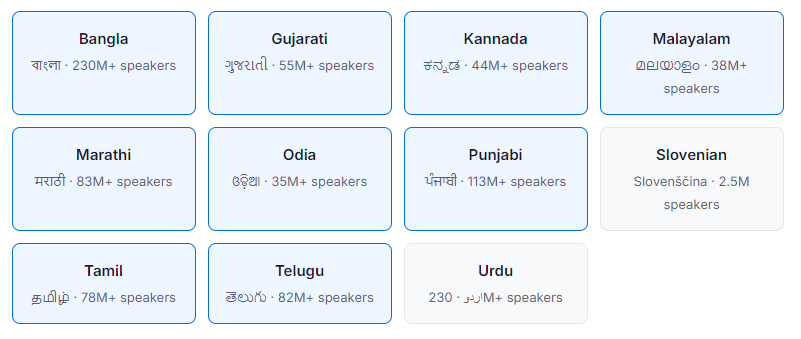
3. The 11 New Languages at a Glance
Combined, the speakers of these 11 languages represent nearly a billion people. Even accounting for overlap with existing English localizations, this is a transformational expansion in addressable audience.
4. Your Localization Playbook: Step-by-Step
Localization is more than translation. A strong localization strategy involves adapting your entire product page — metadata, keywords, visuals, and messaging — to resonate with each target audience. Here is a structured approach.
Step 1: Audit Your Current Localizations
Before adding new languages, review your existing localized listings. Check which markets are driving the most installs, what your conversion rates look like per locale, and where there are gaps in keyword coverage.
✔ ACTION STEP
Go to App Store Connect > App Analytics > Metrics. Filter by territory and storefront. Identify which Indian states or regions already show meaningful install volume — these are your priority languages.
Step 2: Research Local Keywords
Keyword behavior varies dramatically between languages. A direct translation of your English keywords will rarely capture actual search intent in languages like Tamil or Telugu. You need native-language keyword research.
💡EXPERT TIP
Don't translate keywords — discover them. Use native speakers or local ASO consultants to identify how users in each language actually search for apps in your category. The same concept (e.g., "budget tracker") may use entirely different phrasing in Bangla vs. Marathi. Treat each language as a fresh keyword research project.
For keyword research methodology, see: How to Do App Store Keyword Research.
Step 3: Localize Your Metadata
With your keyword research complete, localize the following fields in App Store Connect for each new language:
|
Metadata Field
|
Character Limit
|
Localization Priority
|
|
App Name
|
30 characters
|
Critical — directly impacts search ranking
|
|
Subtitle
|
30 characters
|
Critical — visible in search results
|
|
Keywords Field
|
100 characters
|
Critical — hidden but indexed for search
|
|
Description
|
4,000 characters
|
High — affects conversion rate
|
|
Promotional Text
|
170 characters
|
Medium — updatable without new submission
|
|
Screenshots
|
Up to 10 per size
|
High — primary conversion driver
|
|
App Preview Video
|
Up to 3
|
Medium — strong for engagement
|
💡EXPERT TIP
Character limits work differently with non-Latin scripts. Many Indic scripts use conjunct characters and ligatures. A 30-character limit in Tamil or Malayalam may yield far fewer visible "words" than in English. Draft your app name and subtitle, then test how they render on actual devices before submitting.
For a detailed comparison of how localization works across platforms, read: Comparing App Localization on Google Play and App Store.
Step 4: Submit with Your Next Version Update
Apple requires that localized metadata be added with a new version submission. Plan your localization work to align with your next release cycle. You can localize one language at a time — you don't have to do all 11 simultaneously.
5. Metadata Optimization for New Localizations
Adding a new localization is only the beginning. To maximize impact, treat each localization as a distinct product page optimization project.
Keyword Strategy for Indic Languages
The iOS keyword field gives you 100 characters — a particularly valuable space since it is indexed by Apple's search algorithm but not visible to users. For Indic languages, consider:
- Mix script and transliterated terms. Many Indian users search using romanized spellings of their language (e.g., "paise bachao" instead of the Hindi/Urdu script equivalent). Include both forms where possible.
- Target low-competition, high-relevance keywords. These new localizations will start with minimal competition. Even moderate-volume keywords can deliver disproportionate results.
- Leverage cross-language indexing. Apple sometimes indexes keywords from one localization for nearby regions. Test whether Hindi keywords also improve visibility in Marathi or Gujarati storefronts.
💡EXPERT TIP
Use the 100-character keyword field strategically. Since the app name (30 chars) and subtitle (30 chars) are also indexed, avoid duplicating keywords across these three fields. That gives you an effective 160 characters of keyword real estate per language. Learn more in our guide: How to Optimize the iOS Keyword Field.
Description Localization
While the App Store description is not directly indexed for search on iOS, it plays a crucial role in conversion. A well-localized description signals to users that your app genuinely supports their language and cultural context — not just a machine-translated afterthought.
⚠ COMMON MISTAKE
Machine translation alone is not localization. Google Translate or AI-generated translations of Indic languages frequently produce awkward or inaccurate phrasing. Users notice immediately, and it damages trust. Always have native speakers review and refine your descriptions. Budget for professional localization — the ROI on conversion rate improvements alone typically justifies the cost.
6. Creative & Screenshot Localization Strategy
Screenshots are the single most influential conversion element on the App Store product page. Localizing them is not optional — it is essential.
For a deep dive on creative optimization, see: Creative Optimization & Creative Strategy.
What to Localize in Screenshots
- All text overlays — headlines, captions, and call-to-action text in the target language.
- In-app UI — if your app supports the language, show the actual localized UI in screenshots.
- Cultural context — use imagery, color schemes, and design motifs that resonate with the target audience. For Indian languages, consider festival themes (Diwali, Pongal, Onam) for seasonal campaigns.
- Text direction — Urdu is a right-to-left (RTL) language. Ensure your screenshot layouts and text alignment accommodate RTL rendering properly.
💡EXPERT TIP
Create a modular screenshot template system. Design screenshot frames with swappable text layers and interchangeable UI mockups. This lets you produce localized screenshots at scale without redesigning from scratch for each language. Tools like Figma variables or Sketch overrides make this efficient.
See how creative optimization drives real results: How to Boost Conversion by 35% with Product Page Optimization.
Using Apple's New Localized Badges
Apple has released new App Store download badges in all 11 languages. Use these in your marketing materials:
- Regional landing pages and websites
- Social media ads targeted to specific language demographics
- Influencer marketing kits for regional creators
- Email campaigns segmented by user language preference
7. Prioritization Framework: Where to Start
If you can't localize for all 11 languages at once, use this framework to prioritize based on market size, strategic value, and effort required:
| HIGH |
Bangla, Tamil, Telugu, Marathi |
Largest speaker populations among the new languages. High smartphone penetration in West Bengal, Tamil Nadu, Andhra Pradesh/Telangana, and Maharashtra. Strong existing app demand with limited localized competition. |
| MED |
Gujarati, Kannada, Malayalam, Urdu |
Significant user bases with growing digital adoption. Gujarat and Karnataka are major economic hubs. Urdu opens the Pakistan market alongside Indian Urdu speakers. |
| LOW |
Odia, Punjabi, Slovenian |
Smaller addressable markets but still valuable for apps with existing traction or specific category relevance in these regions. Slovenian is relevant for EU compliance and Slovenian-market apps. |
💡EXPERT TIP
Check your existing analytics first. If your app already sees meaningful traffic from Karnataka, prioritize Kannada — regardless of the general framework. Your own data should always override generic prioritization.
For a practical approach to market expansion, our guide on utilizing app localization to enlarge your app market walks through the decision framework in detail.
Final Thoughts
Apple's expansion to 50 supported localizations is a clear signal: the future of mobile app growth is multilingual and multi-regional. The developers and marketers who treat this as a strategic opportunity — rather than a checkbox exercise — will see compounding returns in organic visibility, conversion rates, and user retention.
India, in particular, represents a market where the gap between opportunity and optimization is massive. Nine new Indian languages mean nine new keyword ecosystems with minimal competition. The window of low competition won't last forever.
Start with the languages that align with your existing user base, invest in genuine localization (not translation), and build a systematic approach to managing multilingual product pages at scale. For developers new to ASO strategy, our App Store Optimization resource hub and advanced ASO localization services are strong starting points.
 COVID-19 UPDATE