COVID-19 UPDATE


Key numbers
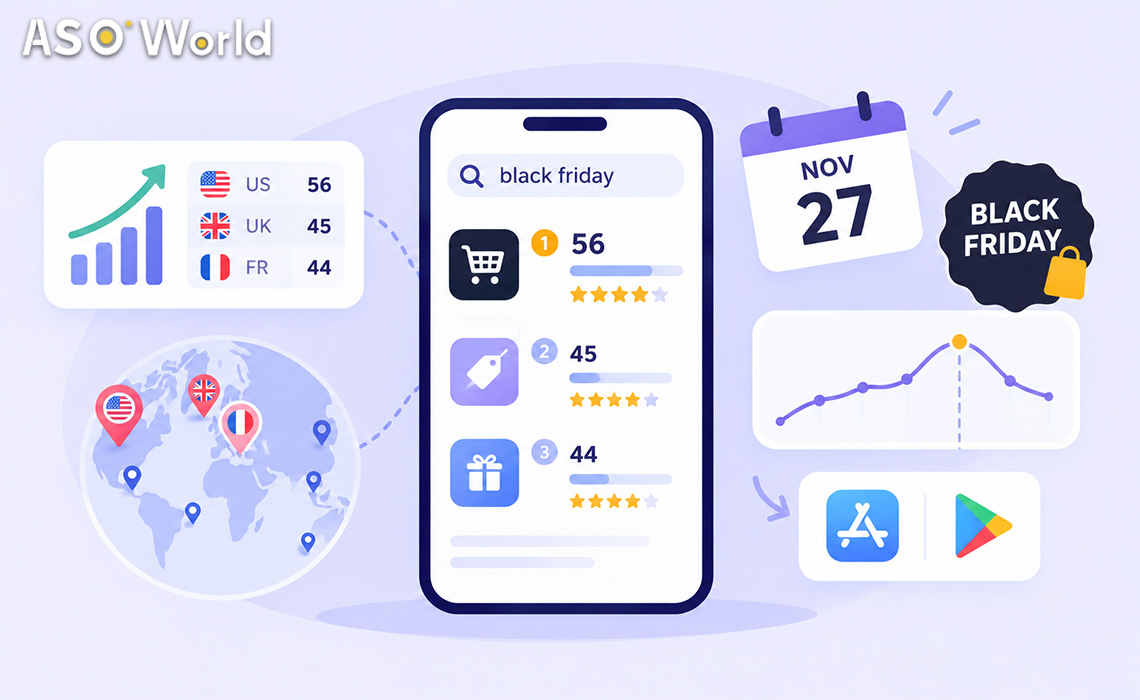
- On 30 October 2026, “black friday” already scores 56/100 in the US, 45 in the UK and 44 in France, while Germany, Canada, Japan, Korea, Brazil and Australia all sit at the index floor of 5 (FoxData popularity, iOS).
- In 2025, deal-app demand in the UK, Germany and France peaked on 23–24 November, four to five days before Black Friday (Temu/SHEIN/Amazon download estimates).
- The US spike was retailer-led and landed on the day itself: Lowe’s and Old Navy each hit an estimated 4.8× their early-November baseline on 28 November 2025.
- “coupons” behaves like an evergreen term: 53 in the US and 54 in Germany on 30 October 2026, versus 5 in the UK.
- English Black Friday long-tails (“black friday deals”, “cyber monday”) read 5/100 in every market where the index returned a value. The long tail wakes up late, and that is your timing window.
Download figures are third-party estimates from FoxData; popularity scores are Apple Search Ads–style indices (5–100). See “About the data” for windows and caveats.
Four weeks before Black Friday 2026 (Friday, 27 November), the real question is where first and how early to target seasonal keywords. Here’s the answer for nine App Store markets.
The head term is already hot in three markets
The seasonal head keyword has already split our nine-country panel into two groups. English-first, Black-Friday-native markets (US 56, UK 45, France 44) have lifted off. Everyone else (Germany, Canada, Japan, Korea, Brazil and Australia) still reads the floor value of 5.
| Keyword | US | GB | CA | DE | FR | JP | KR | BR | AU |
|---|---|---|---|---|---|---|---|---|---|
| black friday | 56 | 45 | 5 | 5 | 44 | 5 | 5 | 5 | 5 |
| coupons | 53 | 5 | 31 | 54 | 5 | 5 | 5 | 5 | 5 |
| deals | 19 | 5 | 38 | 5 | 5 | 5 | – | – | – |
| black friday deals | 5 | 5 | – | – | – | 5 | – | – | – |
| cyber monday | 5 | 5 | – | 5 | – | – | – | – | – |
| christmas shopping | 5 | 5 | 6 | – | – | 5 | – | 5 | – |
Source: FoxData keyword popularity (iOS), snapshot 30 October 2026 | App Store | 9 countries | “–” = no value returned
Note that “coupons” ignores the calendar in the US and Germany (53 and 54). It is a year-round intent term, not a seasonal one.
What this means for your app: if you sell into the US, UK or France and your metadata doesn’t yet contain “black friday”, the window for the head term is open and will get more contested every week. In markets still at 5, a four-week head start costs almost nothing.
Last year, European demand peaked before the day
Popularity tells you what users type; downloads tell you when they actually arrive. Because last season’s popularity history isn’t retrievable from our data source, we use the 2025 download curves of three deal-heavy shopping apps (Temu, SHEIN and Amazon) as a demand proxy, aligned to Black Friday on 28 November 2025.
| Market | Proxy apps’ peak day (2025) | Peak vs early-Nov baseline | Black Friday-day level |
|---|---|---|---|
| US | 27 Nov (Temu, +35%) | 1.3–1.4× | still elevated |
| UK | 23 Nov (Temu +62%) | 1.6× | below baseline (−27%) |
| Germany | 24 Nov (Temu +44%) | 1.4× | below baseline (−21%) |
| France | 23 Nov (Temu +58%) | 1.6× | roughly baseline |
| Japan | 30 Nov (Temu +15%) | ~flat | flat |
| Korea | 24 Nov (Temu +40%) | 1.4× | flat |
| Brazil | 13 Nov (Temu) | ~flat | flat (low confidence) |
| Canada | 8 Nov (Temu +35%) | 1.35× | below baseline |
Source: FoxData download estimates, Temu/SHEIN/Amazon iOS, 20 Oct–5 Dec 2025 | demand proxy | per country
The pattern is uncomfortable for anyone who schedules around the day itself. In the UK, Germany and France, deal-app demand crested four to five days before Black Friday, and on the day Temu’s UK downloads were an estimated 27% below their early-November baseline. SHEIN’s curve was earlier still: its US peak landed on 8–9 November, 19 days before the node.
A note on Brazil: Black Friday is one of Brazil’s biggest retail events, so a flat proxy curve says more about our three proxy apps than about Brazilian demand. Local marketplaces lead there. Treat the Brazil row as low confidence and test Portuguese terms (see below) before drawing conclusions.
What this means for your app: in Europe, your keyword and conversion sprint needs to peak in the 18–24 November window, not on 27–30 November. If your whole campaign is anchored to the day, you arrive after the wave in three of the strongest markets.
The US spike is retailer-led and lands on the day
The US behaves differently. On Black Friday 2025, the iOS Shopping chart’s top-10 entry sat at an estimated 16,472 downloads that day (minimum), with a median of ~43,300 across the ten charting apps. The biggest multipliers belonged to brick-and-mortar retailers going app-first:
| App (US iOS, BF day 2025) | Downloads that day (est.) | vs 1–7 Nov baseline |
|---|---|---|
| Lowe’s (#1 that day) | 45,046 | 4.8× |
| Old Navy (#4) | 36,444 | 4.8× |
| Best Buy (#2) | 16,472 | 1.3× |
| Temu (#3) | 53,401 | 1.1× |
| Shop (#5) | 55,332 | 1.5× |
| Walmart (#6) | 54,391 | 1.5× |
Source: FoxData download estimates, iOS, US | Black Friday 28 November 2025 | Shopping category | estimates are not strictly monotonic with rank
Lowe’s climbed from #31 in the Shopping chart on 26 November to #1 on Black Friday; Old Navy went from #37 to #4 in a single day. These aren’t deal aggregators: their users open the app to execute a purchase they’ve already decided on, so the chart reward lands on the day.
What this means for your app: if you are a US brand or retailer, the node is still your biggest single-day multiplier, but only if brand terms, screenshots, ratings and seasonal messaging are live before Thanksgiving. App Store metadata changes ship with a new app version and go through App Review, so a Thursday-night fix is a gamble.
Where English Black Friday keywords are still asleep
Six of nine markets still read the floor on the English head term. That reflects language as much as calendar. Germany is the clearest example: English “black friday” sits at 5, but “coupons” (an English loanword German shoppers use routinely) already reads 54. German users are clearly shopping; they just aren’t typing the English seasonal phrase in the App Store yet.
The same likely applies to Japan, Korea and Brazil, where shoppers search in their own language. Our panel only measured English terms, so the localised candidates below are hypotheses to test, not measured data:
| Market | Localised seasonal terms to test | Note |
|---|---|---|
| Germany | Black Friday Angebote, Gutscheine, Rabatt | “Black Week” is also common in German retail |
| Japan | ブラックフライデー, セール, クーポン | Japanese retailers widely use the katakana term |
| Korea | 블랙프라이데이, 할인, 쿠폰 | Korea’s own November shopping festival overlaps the window |
| Brazil | black friday, ofertas, cupom, promoção | English “black friday” is used in Portuguese marketing |
Source: ASOWorld localisation suggestions (not FoxData measurements) | validate popularity per storefront before shipping
If you only ship English metadata, you are invisible where seasonal competition is thinnest. If you localise, you enter a seasonal keyword space that is still almost unoccupied, and in 2025 those same markets produced measurable pre-node demand peaks (Korea +40% on 24 November). For a structured way to score these terms by popularity, difficulty and relevance, use ASOWorld’s guide on how to pick the right keywords.
What this means for your app: a lightweight localised Black Friday keyword set for DE/JP/KR/BR (title or subtitle plus part of the 100-character keyword field) buys seasonal visibility at floor-level competition. It is the cheapest asymmetric bet of the season.
The rotation inside the US: deals fall, coupons hold
Inside the US, “deals” dropped from 46 to 19 in six days while “black friday” held at 56 and “coupons” held at 53.
| US term (Oct 2026) | 24–27 Oct | 30 Oct | Read |
|---|---|---|---|
| black friday | 56 | 56 | calendar-driven, stable |
| deals | 46 | 19 | volatile |
| coupons | 53 | 53 | evergreen intent |
Source: FoxData keyword popularity (iOS), US | 7-day window ending 30 October 2026
Generic deal terms swing week to week; seasonal head terms climb with the calendar; coupon intent persists. That argues for a three-layer keyword field:
- Base: evergreen utility terms (“coupons”) that work all year.
- Seasonal: the head term for the node window, in the markets where it has lifted off.
- Opportunistic: a small allocation to volatile generic terms, re-checked weekly rather than set once in October.
What this means for your app: treat volatility as a signal. When a generic term dips, its organic slot is usually cheaper to take; when the head term climbs, make sure your metadata already contains it before competition peaks.
Playbook: what to do next, by budget
Tier 1 – under $1,000. Ship a metadata update now for US/GB/FR: head term in the title or subtitle, evergreen terms in the keyword field, plus localised strings for one floor market. Re-check popularity weekly; a market moving from 5 to 15+ is your signal that it has switched on. Because iOS metadata ships with a new version, build in two days for App Review.
Tier 2 – $1,000–$10,000. Add keyword installs on the 10–25 seasonal and long-tail terms where your app already appears in the top 250 results (a prerequisite on ASOWorld’s page; from $0.20 per install on Android and $0.30 on iOS, verified 30 October 2026). Phase them 2–3 weeks before the node, with a reserve for each market’s local peak (18–24 November for GB/DE/FR, 24–27 November for the US). Keep daily volumes in proportion to your organic baseline.
Tier 3 – $10,000+. Run country-split programmes with separate creatives and keyword sets, and coordinate Apple Search Ads on the head term while organic rank holds. A seasonal and event marketing programme packages the calendar, localisation and campaign phasing into one plan. For the full localisation rewrite across several storefronts, an App Store Optimisation service saves weeks of in-house work.
FAQ
How early should I add Black Friday keywords to my App Store metadata?
For the US, UK and France, where “black friday” already scored 56/45/44 on 30 October 2026, ship before mid-November. Title, subtitle and keyword-field changes require a new app version and App Review; Apple’s stated goal is 90% of submissions reviewed within 48 hours. For floor markets (5/100), 2–3 weeks out still catches the curve.
Which country saw demand peak furthest before Black Friday in 2025?
Among our proxy apps, the UK and France: Temu’s estimated download peak hit 23 November, five days before the node, and UK downloads were ~27% below baseline on Black Friday itself.
Do “black friday deals” and “cyber monday” have volume yet?
Not as of 30 October 2026: both read 5/100 in every market where the index returned a value. Treat them as week-of keywords, not month-of keywords.
Is “coupons” a seasonal keyword?
No. It read 53 in the US and 54 in Germany on 30 October with no seasonal shape. Use it for baseline visibility and let “black friday” terms carry the seasonal spike.
What were the 2025 Black Friday chart thresholds?
US iOS Shopping top-10 on 28 November 2025: minimum ~16,472 downloads that day, median ~43,300 across the ten charting apps (FoxData estimates). Expect 2026 levels to differ.
Does Germany celebrate Black Friday?
Yes, but English “black friday” sat at the 5/100 floor in the German App Store on 30 October while “coupons” read 54. Test German seasonal terms rather than relying on the English phrase.
Get the full country × keyword benchmark table
We’ve packaged the 9-country × 6-keyword popularity snapshot, the 2025 peak-day calendar per market and the BF-day top-10 thresholds into a spreadsheet. Create a free account and download the benchmark table: free, registration required.