COVID-19 UPDATE


Important Notice:Beware of scams using ASOWorld's name for part-time recruitment or ASO earning app activities. ASOWorld is not hiring any part-time staff. Trust only official information posted by ASOWorld.

Technical analysis of iOS 17.5 Beta 1, evaluating EU web distribution compliance frameworks, structural updates, and strategic execution protocols for developers.


Following the deployment of the iOS 17.4 structural baseline, Apple has provided developers with the initial beta iteration of iOS 17.5. This release implements critical system updates and establishes the technical infrastructure for regulatory compliance within the European Union:
>>> Strategic Analysis: Apple's EU DMA Compliance Across iOS, Safari, and the App Store
The beta build, identified as 21F5048F with a file size of 6.48 GB, typically necessitates a comprehensive OS reinstallation—standard protocol for transitions proceeding from public to beta environments. The update explicitly integrates firmware modifications to the modem module, purposed to optimise network connectivity and resolve previously documented transmission anomalies.
To ensure compliance with the EU Digital Markets Act (DMA), iOS 17.5 beta 1 establishes the protocol for developers to distribute applications directly from verified external domains.
This mechanism, designated as "Web Distribution," mandates that developers accede to revised App Store commercial terms. A critical financial parameter is the implementation of a Core Technology Fee (CTF) of €0.50 per first annual installation for volumes exceeding one million within a 12-month fiscal period.
Execution Strategy: Despite utilising server-side web distribution, all application binaries remain subject to Apple's mandatory notarisation protocols to verify security and operational integrity. Developers are required to systematically authenticate their server domains via App Store Connect. Enterprise development teams must conduct a rigorous cost-benefit projection regarding the CTF against standard App Store commission models, whilst simultaneously reinforcing their own server infrastructure and payment gateways.
Authorised developers are subsequently granted access to designated APIs to facilitate system-level functionality integration.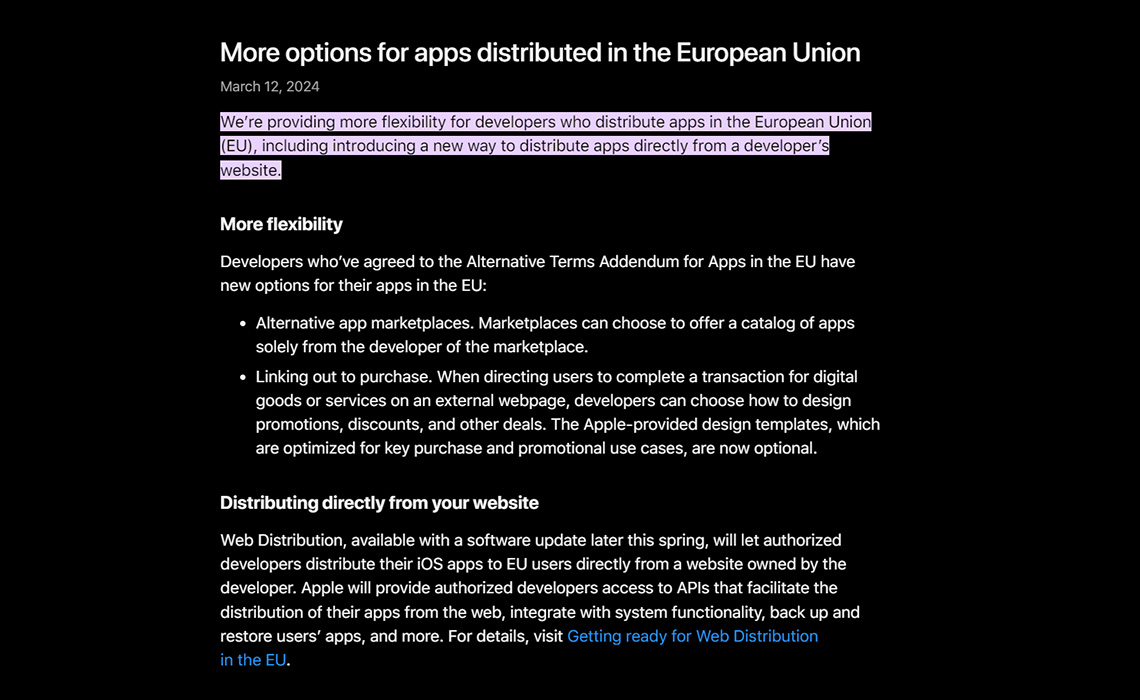
(Source: Apple Developer Documentation)
Diagnostic observations from initial executions reveal that the boot sequence displays an Apple ID verification prompt. The battery diagnostics interface has been modified to feature a 'charging time' metric. Code alignment errors (placeholder text) were observed within these settings, which will probabilistically be rectified in subsequent iteration cycles.
The native Books application has integrated a quantitative progress tracking module for reading metrics. The widget associated with the Podcasts application has been recalibrated to dynamically synchronise its background colour metric with the active media asset.
Within the core privacy and security directories, the graphical user interface has been updated with a newly designed glyph denoting the 'Passkeys Access for Web Browsers' configuration, standardising visual hierarchy.
Click "ASO World" to scale your application infrastructure with robust data-driven application marketing services.
Analysis of this specific beta build confirms that pre-announced functionality, notably Live Activities integration for the stopwatch and Apple Music SharePlay execution, has been excluded from the current compiled manifest.
The associated Dynamic Island animation sequences for the stopwatch function, demonstrated in preceding alpha builds, remain unintegrated.
Development Note: Engineers should temporarily suspend integration testing for beta-dependent APIs associated with these features until they are demonstrably stable within a final Release Candidate (RC).
Historical data parameters suggest iOS 17.5 will follow a bi-weekly beta distribution schedule. The final production release was scheduled for deployment in May 2024, aligning with systemic hardware compatibility updates for accompanying iPad models.
The deployment of iOS 17.5 Beta 1 provides a quantifiable shift toward decentralised application distribution exclusively within the European Union, operating directly under the constraints of the DMA framework.
This update represents an incremental yet legally compliant structural adjustment rather than a functional overhaul of the OS ecosystem. Developers functioning within the EU market must rapidly assess their distribution architectures to leverage these new direct-to-consumer protocols responsibly and securely.
For more technical documentation and analytical insights, please access the iOS Ecosystem Intelligence Hub, and register for industry updates to maintain operational awareness.
Get FREE Optimization Consultation
Let's Grow Your App & Get Massive Traffic!
All content, layout and frame code of all ASOWorld blog sections belong to the original content and technical team, all reproduction and references need to indicate the source and link in the obvious position, otherwise legal responsibility will be pursued.