The biggest lesson from 2025 is clear. App stores no longer show the same app to every user in the same way. Discovery, ranking, and conversion are increasingly personalized. As a result, ASO in 2026 is shifting from keyword tuning to user-focused page design, creative testing, and revenue-driven optimization.
At ASOWorld, this shift is viewed not as a tooling update, but as a structural change in how users discover and evaluate apps across store ecosystems.
This article breaks down what changed in 2025 and where the real ASO growth opportunities are in 2026.
What Will Change in App Stores in 2026?
1. App Store Discovery Is Becoming User-Specific
In the past, ASO success was often measured by ranking position for a fixed keyword. In 2025, both Apple App Store and Google Play moved further toward personalized discovery.
Search results, recommendation placements, and even store page exposure now depend more on user behavior, preferences, and context.
What this means for ASO:
- Ranking alone is no longer the goal.
- Visibility depends on relevance to specific user segments.
- Being shown to the right users matters more than being shown to everyone.
In 2026, ASO must be designed around user intent rather than generic traffic.
💡 Related reading:
>>> Natural Language Processing (NLP) on the App Store
>>> App Intents framework (App Store)
>>> AI Review Summaries (App Store)
>>> Search results tags (App Store)
>>> AI-Powered Guided Search (Google Play)
>>> Expanded Inventory (App Store)
2. One Store Page Is No Longer Enough
A major shift in 2025 was the expansion and wider adoption of customizable store pages.
- Apple continued to develop Custom Product Pages.
- Google Play strengthened Custom Store Listings.
These tools allow developers and marketers to create multiple versions of a store page based on keywords, audiences, or acquisition channels.
This transforms store pages from static brand representations into dynamic conversion assets. Different users respond to different value propositions, and a single universal page can no longer address all high-intent segments effectively.
In practice, managing multiple store page variants requires a clear keyword-to-page mapping and a structured testing roadmap. This is where many teams begin to outgrow ad hoc ASO execution and move toward more systematic ASO strategies, similar to how landing pages are managed in web acquisition.
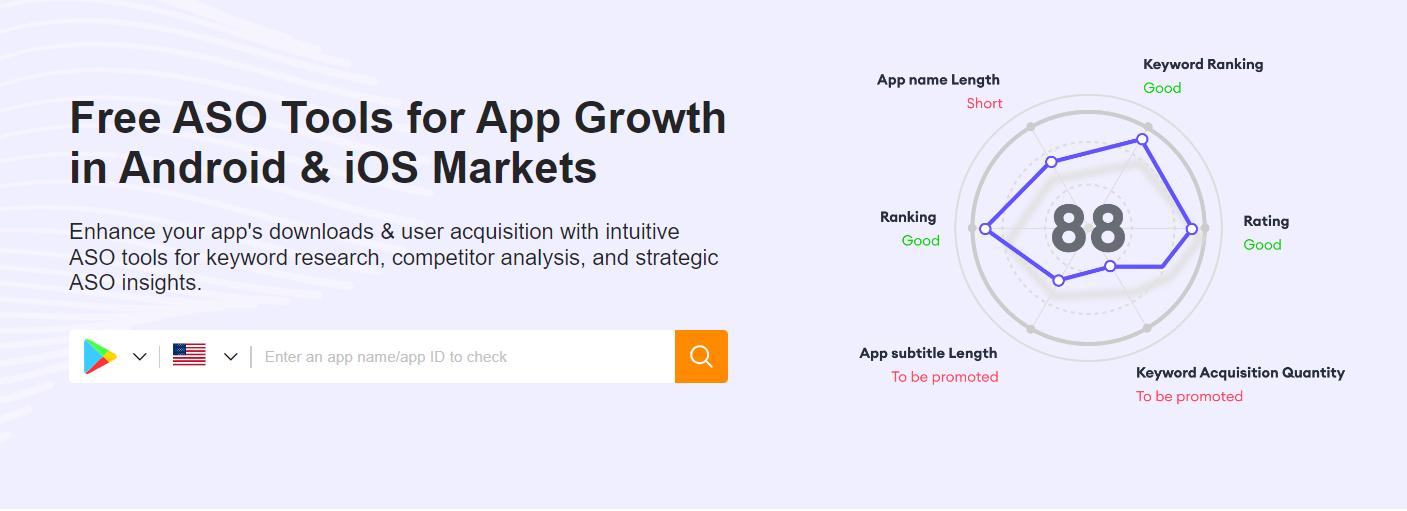
👇 Try free ASO tools to optimize your app store performance
3. Algorithm Updates Increased Volatility
Throughout 2025, many apps experienced noticeable ranking fluctuations following algorithm changes. Traditional optimization tactics such as adjusting titles or short descriptions became less predictable.
Key takeaway:
- ASO is no longer a set-and-forget activity.
- Continuous monitoring and iteration are required.
- Faster testing cycles outperform complex one-time optimizations.
As rankings become less predictable, controlled traffic through selected keywords has increasingly been used to validate page relevance and conversion signals before broader rollouts.
👉 App Stores March 2026 Updates: App Store Optimization Strategies You Should Notice
Best Practices for App Growth in 2026
Audience-Based Store Pages
The strongest ASO growth lever in 2026 will be the ability to match different user intents with tailored store page experiences. Instead of sending all traffic to a single default page, leading teams segment users by motivation and align each group with messaging that reflects their expectations.
This approach improves conversion by reducing the gap between what users are looking for and what they see upon arrival. Over time, it also improves retention by setting clearer expectations before installation. Audience-based pages allow growth without relying solely on higher traffic volumes.
In execution, translating user intent into performance gains often requires more than organic exposure alone. Many teams combine audience-specific store pages with targeted keyword traffic to accelerate learning cycles and strengthen conversion signals at scale.
At ASOWorld, this model is commonly applied through integrated ASO optimization and intent-driven keyword install strategies.
First-Impression Creative Optimization
As attention spans continue to shorten, the first visual interaction with a store page increasingly determines whether an app earns an install. Icons, first screenshots, and preview videos carry disproportionate weight in the decision-making process.
In 2026, creative testing often produces faster and more consistent gains than incremental keyword changes. Teams that treat creative assets as performance variables rather than static brand elements will outperform those that focus only on metadata.
Localization Beyond Translation
Localization in 2025 moved beyond language accuracy.
Different markets respond to different motivations, even for the same feature.
Effective localization now includes:
- Market-specific pain points
- Local usage scenarios
- Culturally relevant visuals and framing
For many apps, proper localization delivers larger conversion lifts than global keyword expansion.
💡 Related reading >>> How Can iOS App Product Page Localization Improve Your ASO Performance?
ASO Tied to Revenue, Not Just Installs
Another clear shift in 2025 was the growing importance of post-install performance.
High download volume without retention or monetization no longer supports sustainable growth.
In 2026, ASO decisions should be evaluated based on:
- Retention quality
- Conversion to paid users
- Long-term user value
This is where intent-focused ASO and keyword-driven acquisition begin to differentiate. When analyzed through lifetime value rather than install counts, targeted keyword strategies frequently outperform broader volume-based approaches, even at lower scale.
Speed of Testing as a Competitive Advantage
The most consistent ASO gains will come from execution speed. App stores, competitors, and user behavior evolve too quickly for static strategies to remain effective.
Teams that run small, frequent experiments and apply learnings across markets will compound results over time. In this environment, fast feedback loops matter more than complex frameworks or infrequent major redesigns.
The New Role of ASO in 2026
ASO is no longer limited to improving visibility in app stores. It now sits at the intersection of user acquisition, conversion optimization, and revenue strategy.
In practical terms, ASO in 2026 is about matching the right users with the right message and measuring success through business outcomes rather than surface metrics. This requires coordinated execution across keywords, store pages, creative assets, and acquisition channels.
Conclusion
The transition from 2025 to 2026 marks a clear shift in ASO priorities.
ASO is moving from keywords to audiences, from rankings to relevance, and from installs to long-term value. Teams that treat store pages as dynamic, testable, and revenue-linked assets will define the next stage of app growth.
For teams reassessing their ASO roadmap for 2026, the key question is no longer which keywords to rank for, but which users to attract and how to convert them efficiently. This is where structured ASO execution and intent-driven keyword strategies can create measurable, sustainable impact.
 COVID-19 UPDATE