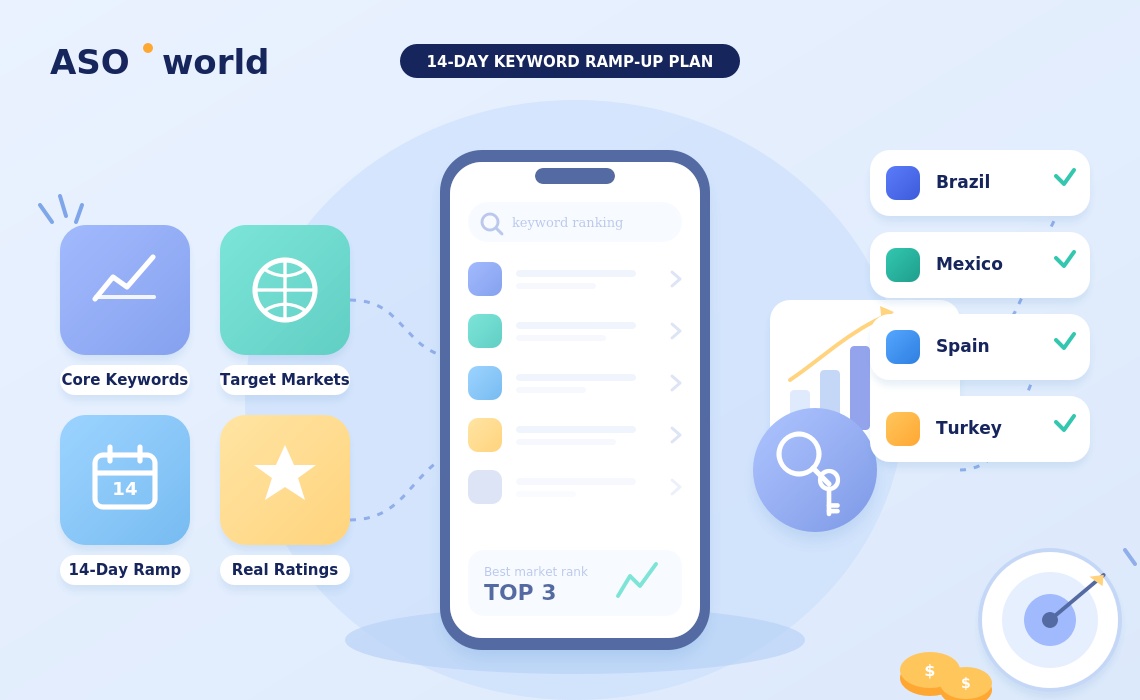
- If your budget can't win US head terms, don't start there. Your core keywords in less-crowded countries can often reach the top 3 on a fraction of the spend, and those wins build the install history and ratings you'll need later.
- Use a 14-day ramp-up: start small, increase volume every other day, and never leave gaps. Steady signals beat big bursts on both App Store and Google Play.
- Let ratings grow from real, keyword-driven installs. Add a small number of high-quality reviews each day. Don't drop hundreds at once.
- Split budget roughly 70% iOS / 30% Google Play as a starting point, then move money toward the country and platform that respond first.
- Below: how to pick countries, the day-by-day plan, what results to expect and when to scale.
Why start in less-crowded countries instead of the US?
The US App Store is the most competitive keyword market there is. For head terms in crowded categories, established apps defend their positions with thousands of installs a month. A small budget spread across those terms usually moves your app from position 48 to position 31. That's still invisible, and the money is gone.
Less-crowded markets work differently. Many countries have real search volume but far fewer apps with fully localized listings competing for the same terms. Localization research points to markets like Brazil, Mexico, Spain, France, Germany, Italy, Turkey, Poland and the Netherlands as places where competition is often weaker outside gaming. We keep seeing the same thing in live campaigns: core keywords in less popular markets reaching the top 3 on budgets that wouldn't register in the US.
There's also a compounding benefit. Rankings, installs and ratings earned in these markets make your app look stronger everywhere. So when you do step into tougher markets, you start from a better position.
Step 1: How do you pick the right countries?
Score each candidate country on four questions before you spend anything:
| Question |
How to check |
Good sign |
| Is there real search volume for your core terms? |
ASO tool volume score, store autocomplete |
Volume ≥ moderate for 3+ core terms |
| Is your app already indexed? |
Check your rank for each keyword in that country |
Ranked within the top 250 (required before keyword installs can help) |
| How strong is the current top 10? |
Look at ratings count and localization of the top 10 apps |
Several top-10 apps are not localized, or have few ratings |
| Can your listing convert there? |
Localized title, subtitle and screenshots |
At least metadata localized; screenshots localized if possible |
Pick 2–3 countries to start. More than that spreads a small budget too thin. Fewer gives you no comparison.
Step 2: How do you choose keywords for a small-budget ramp-up?
For each country, build a short list:
- 2–3 core terms that describe exactly what your app does
- 5–8 long-tail terms (feature + use case, like "pdf scanner offline" or "sleep sounds for baby")
Keep the list short. The goal of the first 14 days isn't coverage. It's to prove you can hold top positions on a few terms that matter.
Step 3: The 14-day keyword install ramp-up plan
The logic is simple: start small, increase every other day, keep it continuous. Both stores reward consistency. Google Play typically needs a 7–9 day cycle for rankings to settle. iOS reacts faster but loses rankings quickly if activity stops, so it needs at least 3 days of steady activity at a time.
| Days |
Daily volume per keyword (relative) |
What you're doing |
What to watch |
| 1–2 |
1× (baseline) |
Launch all selected keywords at a small, equal volume |
Installs delivered on schedule; no gaps |
| 3–4 |
1.3× |
First step up |
Long-tail terms start to move on iOS |
| 5–6 |
1.6× |
Second step up |
Which country responds first |
| 7–8 |
2× |
Hold and compare |
Google Play ranks begin to settle; drop the weakest keyword and move its budget |
| 9–10 |
2.4× |
Concentrate on winners |
Top-10 entries on long tail; core terms climbing |
| 11–12 |
2.8× |
Push the best core term |
Top-3 attempts on core keywords in the best country |
| 13–14 |
Hold at 2.8× |
Don't cut abruptly |
Rank stability for 48 hours at peak volume |
Rules that make or break the plan:
- No gaps. A missed day on iOS can undo three days of progress.
- Every other day, not every day. Gradual steps look like natural growth and give you time to read results.
- Reallocate, don't just add. By day 7 you'll know which country and keywords respond. Shift budget there instead of raising everything.
- Don't stop at day 14. Move into a lower "maintenance" volume that keeps your rankings instead of dropping to zero.
You can set up a keyword install campaign per country and keyword from one dashboard. Pricing currently starts from about $0.16 per install on Android and $0.24 on iOS (check the page for live pricing). A keyword-ranking guarantee option is available that targets the top 1–5 within about 7–10 days.
Step 4: How should ratings and reviews grow during the ramp-up?
This is where many small-budget campaigns go wrong. When rankings start to move, it's tempting to add a big batch of ratings "to help conversion". Don't.
- Rating bursts are easy to spot. A rating curve that climbs much faster than organic downloads is exactly the pattern stores filter. We've seen whole batches of five-star ratings removed during campaigns built this way.
- Reviews are filtered more aggressively than ever. Apple in particular delays and filters reviews, and apps with free-trial models draw extra scrutiny.
- Low ratings usually point to a traffic problem. If a rating won't move, the users arriving probably aren't the users the app was built for. Keyword-driven installs bring people who actually searched for what you do, and they're the ones most likely to leave good ratings on their own.
The pattern that works:
- Let keyword installs build natural ratings as the main engine.
- Add a small number of high-quality written reviews per day (think one per day, not dozens).
- If you add reviews, use a service with a retention guarantee. With guaranteed reviews, more than 80% of ordered reviews must stay live for 30 days or longer, or you're refunded.
- If your rating is already hurting conversion, deal with that first through rating recovery and review management. Apps rated 4+ stars can convert at close to double the rate of apps rated 3 stars or below.
What results should you expect after 14 days?
Results depend on category, country and starting rank. Here's what a healthy ramp-up usually looks like at the end of two weeks:
| Metric |
Typical healthy outcome |
Warning sign |
| Long-tail keywords |
Several in the top 10 in at least one country |
None moved into the top 40 → check indexing and relevance |
| Core keywords |
1–2 in the top 5 in the best-performing country |
Rank rises then collapses → volume steps were too big, or there were gaps |
| Organic installs |
Rising alongside ranking |
Rankings up, installs flat → conversion problem (icon, screenshots, rating) |
| Ratings |
Growing gradually, in line with installs |
Rating count jumps ahead of installs → slow down |
For reference, one published keyword ranking case reached top 3 rankings for all target keywords, a 160% increase in daily downloads and a 60% uplift in conversion rate. Broader multi-market ranking programs have delivered a 180% increase in store visibility and a 108% uplift in organic installs.
When should you expand to more countries or harder keywords?
Scale when all three of these are true:
- At least one core keyword has held the top 5 for 5+ days without extra volume.
- Organic installs in that country are clearly above where they were before the campaign.
- Your rating is stable or improving.
Then choose one of these:
- Go wider: copy the same 14-day plan into 1–2 more countries with a similar profile. Running several markets at the same time is increasingly common, and it helps because each market's installs and ratings strengthen the app overall.
- Go deeper: move up to harder core terms in your proven country, keeping the same step-up pacing.
- Go bigger: only after both of the above. That's when a competitive market like the US starts to make sense, with realistic expectations. Head terms there can need thousands of installs a month.
Common mistakes in small-budget ramp-ups
- Starting at full volume on day 1. It looks unnatural and leaves you no room to learn.
- Stopping for the weekend. Gaps hurt iOS rankings most.
- Spreading the budget over too many countries. Two or three well-funded markets beat eight underfunded ones.
- Buying ratings to "fix" conversion. Fix the traffic quality and the listing. Ratings follow.
- Running your own paid campaigns at the same time without tracking them apart. Overlapping campaigns make it impossible to tell what's working. Tag and separate them.
- Expecting reviews in every language to go out at the same speed. Written reviews in some languages (Russian, Japanese and other smaller markets) have limited capacity and take longer, so plan for that.
FAQ
Can a small budget really get an app into the top 3?
In the right country, for the right keywords, yes. Core keywords in less-crowded markets regularly reach the top 3 on budgets that wouldn't move US head terms. Start with 2–3 countries and a short keyword list.
Why 14 days and not 7?
Google Play rankings usually need 7–9 days to settle, so a 7-day test ends just as the results become readable. Fourteen days gives you one full cycle to learn and one to concentrate on the winners.
Should I split my budget between iOS and Google Play?
A 70/30 iOS-to-Google Play split is a common starting point. After the first week, move money toward whichever platform and country responded first.
How many reviews should I add during a ramp-up?
Very few. Let keyword-driven installs create natural ratings, and add a small number of quality written reviews each day. Sudden spikes are the pattern stores filter most.
What if my app isn't in the top 250 for a keyword?
Keyword installs can't help that keyword yet. Update your title, subtitle or keyword field (iOS) or your description (Google Play) so the app gets indexed, then include it in the next ramp-up.
What happens after day 14?
Drop to a lower maintenance volume instead of stopping. Then either copy the plan into new countries or step up to harder keywords in the country that worked best.
 COVID-19 UPDATE