COVID-19 UPDATE


Important Notice:Beware of scams using ASOWorld's name for part-time recruitment or ASO earning app activities. ASOWorld is not hiring any part-time staff. Trust only official information posted by ASOWorld.

Learn how to safeguard your Android app from Google Play removal. Discover key policy compliance strategies, common violation pitfalls, and expert prevention tips for developers.


On 8 April 2026, Google quietly delisted Doki Doki Literature Club (DDLC)—one of the most critically acclaimed indie visual novels of the past decade—from the Google Play Store. The stated justification? A breach of Google’s Terms of Service regarding the title's “depiction of sensitive themes.”
The statistics make this delisting particularly noteworthy. The free tier of DDLC had amassed over 30 million downloads across various platforms. On Google Play alone, the premium “Plus” edition had garnered over 20,000 user reviews with a near-perfect rating. The application was accurately categorised as “Mature 17+”, opened with an explicit content warning (“This game is not suitable for children or those who are easily disturbed”), and featured in-app settings providing further content warning toggles.
Publisher Serenity Forge immediately contested the decision, releasing a public statement defending the game's treatment of mental health topics and confirming efforts to secure DDLC's reinstatement. Notably, the software remains accessible on iOS, Steam, Nintendo Switch, PlayStation, and Xbox—indicating either a divergence in how platforms interpret similar content guidelines or a flaw within Google's enforcement protocols.
For application developers and marketing professionals, this occurrence delivers a stark warning: no application is too prominent, too highly rated, or too seemingly compliant to be shielded from sudden removal. If a title with 30 million downloads and correct content labelling can be withdrawn overnight, any asset in your portfolio is vulnerable to a similar outcome.
This comprehensive article delivers an actionable framework to safeguard your application from Google Play delisting—whether you are developing a game, a utility, a fintech solution, or a content platform. For a broader examination of delisting risks, consult our extensive guide on safeguarding your Android application against Google Play removal.
The removal of DDLC is not an isolated incident. Google Play executes policy enforcement on a massive scale, and the figures are empirical proof of this vigilance. To comprehend the sheer volume, examine data from FoxData, a competitive intelligence platform monitoring real-time release and delisting dynamics across application storefronts.
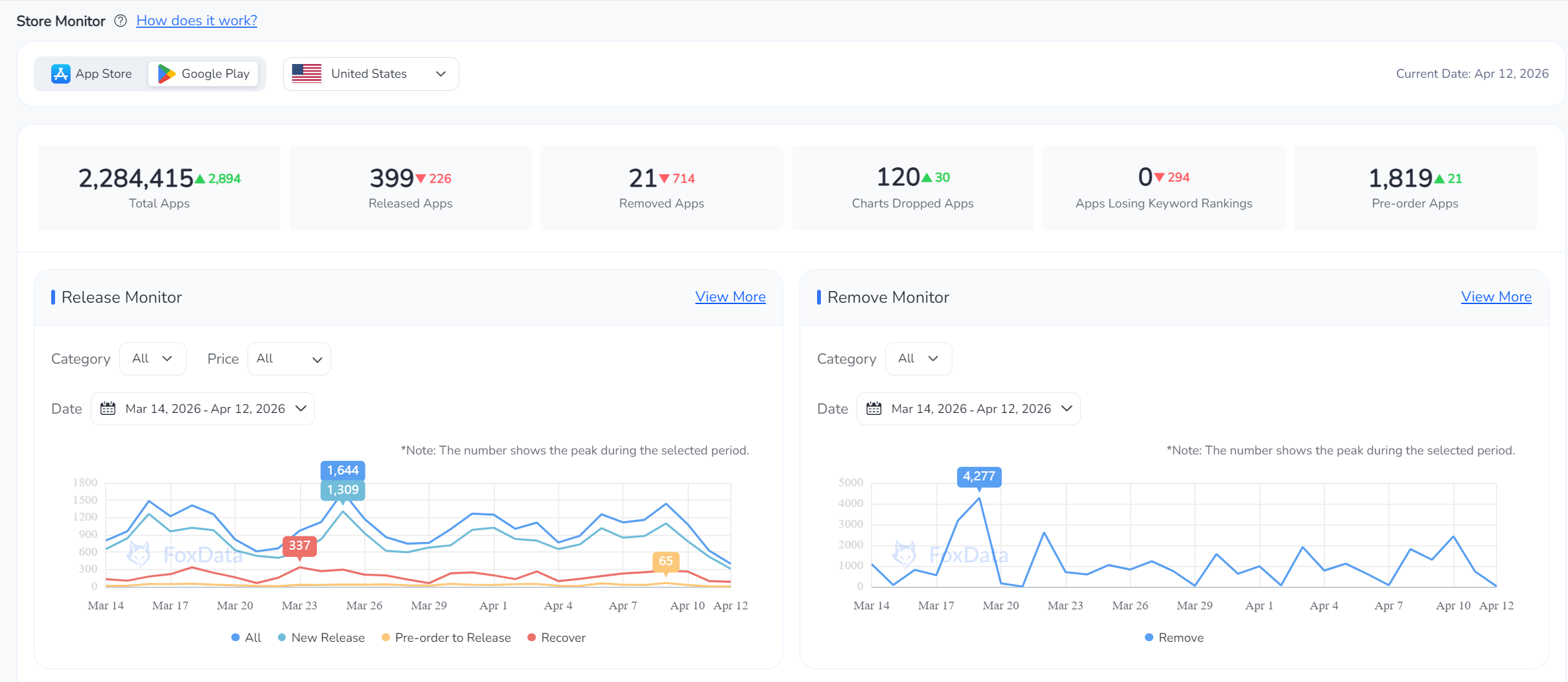
FoxData Store Monitor — US Google Play, 14 Mar – 12 Apr 2026.
Review the Remove Monitor chart above: during a single enforcement wave around 17 March, Google delisted over 4,200 applications in a single day. Even during quieter periods, daily removals standardly fluctuate between 500 and 1,500. Over the 30-day timeframe depicted, the US Google Play Store recorded a net increase of merely 2,894 applications despite hundreds of daily submissions—because removals occur at a commensurate rate.
These spikes in delistings frequently correspond with policy enforcement cycles—intervals when Google batch-processes compliance audits following recently announced policy revisions. This is precisely why monitoring policy timelines is paramount. For the most recent updates, explore our analysis of the March 2026 Google Play policy amendments.
Before exploring protective strategies, one must understand the violation categories that prompt removal. Based upon Google's published guidelines and historical enforcement behaviours, the primary catalysts include:
Sensitive / Restricted Content
Depictions of violence, self-harm, sexual material, hate speech, or substance misuse that exceed the stated content rating or breach absolute prohibitions.
Privacy & Data Policy Violations
Undisclosed data harvesting, absent privacy policies, failure to adhere to data safety section mandates, or COPPA breaches concerning child-directed materials.
Misleading Metadata
Keyword stuffing, fabricated screenshots, exaggerated feature claims, brand impersonation, or descriptions misaligned with the application's true functionality.
Malware, Security & Spam
Malicious software, deceptive advertisements, applications that crash upon launch, duplicate submissions, or software existing purely to redirect users to external websites.
Regulatory / Category-Specific
Non-compliance with strict requirements for finance, health, gambling, or VPNs. Google has rigorously tightened regulations in sectors such as Health Connect and financial services.
Outdated / Abandoned Apps
Applications targeting obsolete API levels, failing to satisfy new user engagement criteria, or remaining unmaintained for prolonged periods.
The DDLC scenario falls directly into the first classification: sensitive content enforcement. However, what makes it particularly notable is that the developer adhered to numerous best practices—age ratings, content warnings, contextual treatment of themes—yet still faced removal. This highlights a stark reality: compliance is necessary but may not be entirely sufficient. Layered defences are critical.
Below is a comprehensive framework. Each element represents an operational protocol you should integrate this quarter.
Google Play revises its policies several times annually, with enforcement deadlines arriving as swiftly as 30 days post-announcement. Missing a single update cycle can render your application non-compliant without your awareness.
The DDLC incident illustrates that even a “Mature 17+” rating offers insufficient defence if Google concludes the content fundamentally breaches a strict policy boundary. Content ratings indicate the appropriate audience; they do not provide blanket authorisation for all material types.
Assuming a correct content rating guarantees immunity. Google establishes absolute prohibitions—certain materials (e.g., graphic depictions of self-harm, unlicensed real-money gambling) are explicitly banned irrespective of age ratings. A mature categorisation does not bypass these boundaries.
Your app's store listing—title, description, screenshots, icon, and promotional assets—is governed by its own regulatory framework. Metadata breaches are amongst the most frequent causes of suspensions, yet they are strictly avoidable. For an exhaustive breakdown of metadata best practices, consult our guide to maximising your application's metadata.
Privacy enforcement has evolved into one of Google Play's most stringent compliance sectors. The Data Safety section operates as a legally binding compliance document actively audited by search mechanics.
This strategy directly maps to the DDLC case parameters. If your application processes mental health, geopolitical content, regulated substances, or parallel sensitive vectors, good intent is insufficient; documented, reviewable infrastructure is mandatory.
Deploying "artistic merit" defences absent programmatic compliance infrastructure. Automated review routines flag heuristics, not subjective intent. Your compliance architecture requires both machine readability and human logical auditing.
The most optimal mitigation strategy involves identifying vulnerabilities independent of Google's algorithms. Systematise a compliance phase within your CI/CD pipeline. Our App Update Optimisation Checklist charts a comprehensive 30+ step framework for this variable.
Operating a pre-defined appeals framework compresses operational response windows exponentially in a crisis event.
The DDLC case emphasises a critical strategic insight: maintaining a multi-platform presence transforms a platform removal from a critical operational failure into a manageable disruption.
ASOWorld First Order Discount
Get 50% off on your first order to start your app growth!

Compliance constitutes a continuous operational posture, not a singular milestone. Navigating enforcement cycles effectively strictly relies upon situational market awareness.
As highlighted by the FoxData Store Monitor statistics, platform intelligence tools deliver macro-level visibility inaccessible from an isolated Play Console dashboard. Observing an aggregate spike in localised category removals flags an immediate imperative to self-audit.
Core functionalities required within store monitoring pipelines:
Platform monitoring scales optimally when fused into broader asset optimisation practices. To construct a holistic framework, review our materials detailing methods for enhancing user ratings and feedback, navigating the Google Play publication process securely, and optimising digital storefront pages systematically.
The removal of Doki Doki Literature Club from Google Play transcends a singular digital narrative. It stands as a structural indicator that platform risk is substantive, algorithmic enforcement actions are absolute, and compliance demands a proactive, engineered stance.
Developers mapping Google Play policy adherence as an afterthought invariably suffer attrition during enforcement sweeps. Conversely, operations treating and funding compliance as a fundamental technical pillar—implementing quarterly audits, surveillance frameworks, documented protocols, and diversified distribution—construct resilient commercial enterprises.
Initiate risk mitigation via the strategies defined in this assessment. Audit technical assets against the aforementioned domains. Establish telemetry pipelines. And decisively construct appeals infrastructure prior to requiring its deployment.
 Mobile App Growth,Google Play Store Ranking Algorithm,
Get FREE Optimization Consultation
Let's Grow Your App & Get Massive Traffic!
All content, layout and frame code of all ASOWorld blog sections belong to the original content and technical team, all reproduction and references need to indicate the source and link in the obvious position, otherwise legal responsibility will be pursued.