COVID-19 UPDATE


A sudden Google Play keyword ranking drop is rarely a penalty — it is almost always one of three things: an algorithm re-evaluation window after an update, a performance-signal gap (installs or engagement failed to keep pace with your previous ranking), or increased competitive pressure on the same terms. Recovery follows a predictable pattern once you identify which of the three you are dealing with.
Below is the recovery curve, what sets Google Play apart from the App Store on this specific issue, and a real (de-identified) recovery case with the actual numbers.
The Panic Moment: Your App Was Ranking, Now It Isn’t
You check your keyword rankings and a term you were sitting at position 6–8 for last week is now nowhere in the top 30. Nothing about your listing changed. The immediate assumption is usually “Google penalised us” — but Google Play’s ranking algorithm does not work through discrete penalty events for the vast majority of cases. It works through continuous re-scoring based on relevance and performance signals, which means a drop is a signal change, not a punishment.
Why Google Play Rankings Actually Drop
1. Post-update re-evaluation. Every app update resets some portion of the algorithm’s confidence in your current performance data. Google Play needs fresh signal to confirm the update did not change quality, load time or crash rate. This produces a temporary dip that is structurally similar to what happens after any app update — a documented, expected pattern rather than a targeted action against your app.
2. Performance signal decay. If your install or engagement velocity for a keyword slows relative to competitors — even without any drop in absolute numbers — your relative ranking can fall because Google Play ranks competitively, not on an absolute quality score.
3. Competitive displacement. Sometimes nothing about your app changed at all. A competitor launched a keyword install campaign, refreshed their metadata, or simply had a strong organic week, and the ranking positions shifted around you.
4. Keyword field or metadata drift. Less common, but worth ruling out: if a recent update altered your title, short description or long description in a way that diluted keyword density for a specific term, that term’s relevance score drops independently of performance.
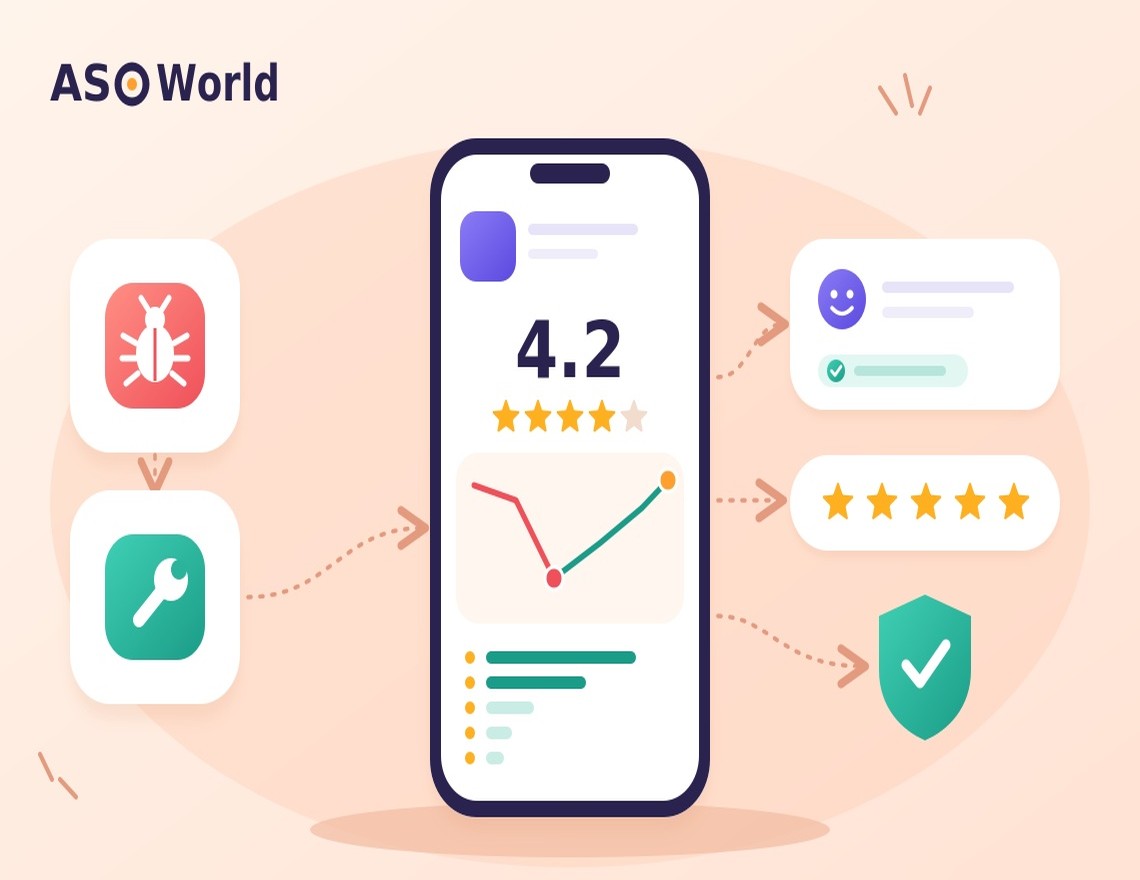
The Typical Recovery Curve
Ranking drops and recoveries tend to follow a three-phase pattern rather than a straight line back up:
| Phase | Timeframe (typical) | What’s happening |
|---|---|---|
| Initial drop | Days 0–3 post-update or post-signal-change | Algorithm discounts prior confidence; ranking falls faster than the underlying quality actually changed |
| Trough | Days 3–10 | Ranking sits at its lowest point while new performance data accumulates; this is the phase where panic-driven metadata rewrites do the most damage, because they reset the evaluation clock again |
| Recovery | Days 10–21+ | Ranking climbs back toward (or past) its prior position as fresh performance signal confirms quality; full recovery for competitive terms can extend to 3–4 weeks |
The critical mistake most developers make is intervening during the trough. Changing your title, description or keyword field while the algorithm is mid-re-evaluation restarts the confidence-building process from a lower baseline — often extending what would have been a 2-week recovery into 5–6 weeks.
Google Play vs. App Store: Why the Recovery Timeline Differs
| Factor | Google Play | App Store |
|---|---|---|
| Ranking signal window | Longer behavioural window; weighs sustained engagement over more days | Shorter feedback loop; can show ranking movement within 24–72 hours of a change |
| Sensitivity to updates | Higher — frequent updates can extend re-evaluation cycles if released too close together | Lower — App Store ranking is comparatively more stable across routine updates |
| Recovery driver | Sustained install and engagement consistency over 2–3+ weeks | Faster response to keyword/metadata correction, but still requires real performance signal to fully confirm |
Practical takeaway: if you are managing both platforms, do not apply an iOS recovery timeline to a Google Play drop — patience windows that are reasonable on one platform will look like inaction on the other, and vice versa.
A De-Identified Recovery Case
One mid-sized utility app saw a core keyword cluster slide out of the top 20 following a routine update cycle. Rather than rewriting metadata mid-drop, the team ran a structured keyword ranking improvement programme — combining keyword research to confirm the target terms were still the right ones, and targeted keyword installs to rebuild the performance signal the algorithm needed to re-confirm relevance.
The results, measured against the pre-drop baseline: the targeted keyword set returned to top-3 rankings, daily downloads increased 160%, and conversion rate on the listing improved 60% — the conversion lift coming largely from the ranking recovery itself restoring the app’s visibility to users already searching with strong intent.
The pattern worth extracting: the fix was not a metadata rewrite. It was re-supplying the specific signal (real search-and-install behaviour) that had decayed, targeted at keywords that were already validated as correct.
Recovery Checklist: What To Do (and Not Do) During a Drop
Do:
- Confirm the drop is real and sustained (3+ days) before reacting — single-day fluctuations are normal noise.
- Check whether the drop correlates with a recent update, a competitor’s launch, or neither.
- Run a visibility-vs-conversion diagnostic to confirm whether you are still being shown (just lower) or have dropped out of the index entirely.
- If the keyword list is still valid, focus on rebuilding performance signal rather than rewriting metadata.
Don’t:
- Change your title, keyword field or description mid-trough unless you have confirmed a specific metadata cause.
- Assume a drop is a penalty and submit an appeal — Google Play’s standard ranking algorithm does not issue “penalties” for typical ranking fluctuation, so there is usually nothing to appeal.
- Wait indefinitely without action — if a term has not shown any recovery movement after 3–4 weeks, the keyword itself (not just the algorithm’s evaluation window) may need re-validating.
- Panic-launch an unrelated visibility campaign (like broad package installs) when the actual gap is keyword-specific — if your goal is a specific term’s ranking, keyword installs targeted at that term are the more direct lever than general download volume campaigns.
Frequently Asked Questions
How long does it take to recover from a Google Play ranking drop?
Most drops tied to updates or normal algorithm re-evaluation resolve within 10–21 days if left alone or supported with performance-signal rebuilding. Drops tied to genuine competitive displacement can take longer and may require expanding your keyword strategy rather than waiting.
Should I roll back my app update if rankings drop right after?
Not automatically. A short post-update dip is expected behaviour in most cases. Only consider a rollback if the drop is unusually severe (dropping out of the index entirely, not just falling in position) or coincides with crash reports or negative reviews about the update itself.
Is a Google Play ranking drop the same thing as a penalty?
No. Google Play’s standard algorithm re-scores continuously based on relevance and performance; it does not issue discrete penalties for ordinary ranking fluctuation. Sudden removal from search results entirely is a different and much rarer situation, usually tied to a policy violation rather than ranking mechanics.
Can keyword installs actually help recover a ranking drop, or is that just masking the problem?
When the underlying keyword list is still correct and the drop is a performance-signal gap, targeted keyword installs supply exactly the signal the algorithm is waiting to re-confirm. It becomes “masking the problem” only if the keyword itself is no longer a realistic match for your app or its competition — which is why confirming the keyword list first matters more than the traffic source you use to rebuild signal.
Does this recovery pattern apply the same way to the App Store as Google Play?
The general phases (drop, trough, recovery) apply to both, but the timeline compresses on the App Store, which reacts faster to metadata and keyword corrections. Google Play requires more sustained behavioural signal over a longer window before confirming a ranking recovery.
Still unsure whether your drop is a performance-signal gap, a keyword problem, or normal post-update noise? Work through the recovery checklist above before committing budget to any single fix.