Google Maps is poised to revolutionise the user journey through the integration of advanced generative AI technology, an initiative engineered to elevate data-driven location discovery.
This update deploys sophisticated large language models (LLMs) to cross-reference an extensive repository of geographic data and user-contributed content, delivering hyper-personalised algorithmic recommendations.
AI-Powered Personalised Discovery
A Conversational Approach to Search
The generative AI framework interprets user queries via conversational language formulation, facilitating a more intuitive search interface. Users can submit descriptive, long-tail phrases—such as “venues with a vintage aesthetic in London”—and receive algorithmically curated suggestions augmented by visual data and aggregated reviews. For digital marketers and business operators, this indicates a structural shift toward semantic search, necessitating local profiles to be optimised with natural-language attributes rather than rigid keyword structures.
Contextual Follow-Up for Comprehensive Assistance
The updated AI architecture is capable of retaining query context, enabling sequential follow-up interactions. For instance, following an initial search for "cultural activities in Tokyo", the system anticipates subsequent refinements and filters location parameters aligning strictly with the user's previously stated parameters. This contextual persistence highlights the critical importance of multi-layered categorisation for entities relying on location-based services.
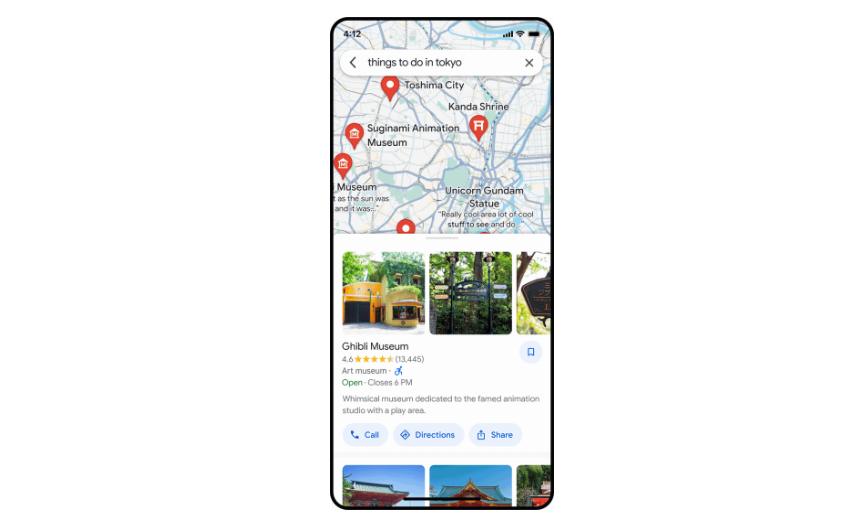
(Source: Google)
Selective Rollout and Future Expansion
Early Access for Local Guides
This capability is currently operating as an early-access programme, deployed initially to a selected cohort of Local Guides in the US. By leveraging this established community—which is structurally dedicated to validating and enriching platform data—Google is systematically testing the AI model's accuracy, mitigating algorithmic bias before instigating a broader public release.
Global Availability on the Horizon
Although a definitive deployment schedule remains pending, Google's strategy indicates a clear intention to expand this functionality to international markets. This expansion transforms Google Maps from a standard geospatial navigation utility into a bespoke discovery ecosystem. Organic search specialists and app developers must utilise this transitional phase to audit location data assets in preparation for AI-mediated visibility mapping.

Click "Access Data-Driven ASO Strategies" to aggressively scale your application and gaming portfolio with objective market metrics via ASO World.
Comments
The incorporation of generative AI into Maps marks a pivotal milestone in digital cartography and platform architecture.
By restructuring search query dynamics, Google Maps is cementing its operational utility not merely for spatial navigation, but as an intent-driven interface for global exploration.
For digital operations and marketing entities, this shift reinforces a critical empirical trend: accommodating conversational AI in the foundational user experience necessitates an immediate recalibration of organic visibility methodologies and semantic data structures.
>>> AI-Driven App Growth Marketing

 COVID-19 UPDATE