COVID-19 UPDATE


Key numbers
- The window is fixed: 28 days from 30 October to Black Friday (27 November 2026), and in 2025 UK, German and French demand peaked 4–5 days before the node.
- A US iOS Shopping top-10 seat on Black Friday 2025 took an estimated median of ~43,300 downloads that day; the top-25 line currently runs about 61K downloads a week (#24, est.).
- At current ASOWorld list prices, closing a 53K-a-week gap for three weeks costs roughly $42,000–$52,000, so a US Shopping category push is a Tier 3 decision, not a Tier 2 one.
- “black friday” popularity on 30 October 2026: 56 (US) / 45 (UK) / 44 (FR); six of nine tracked markets still sit at the floor of 5.
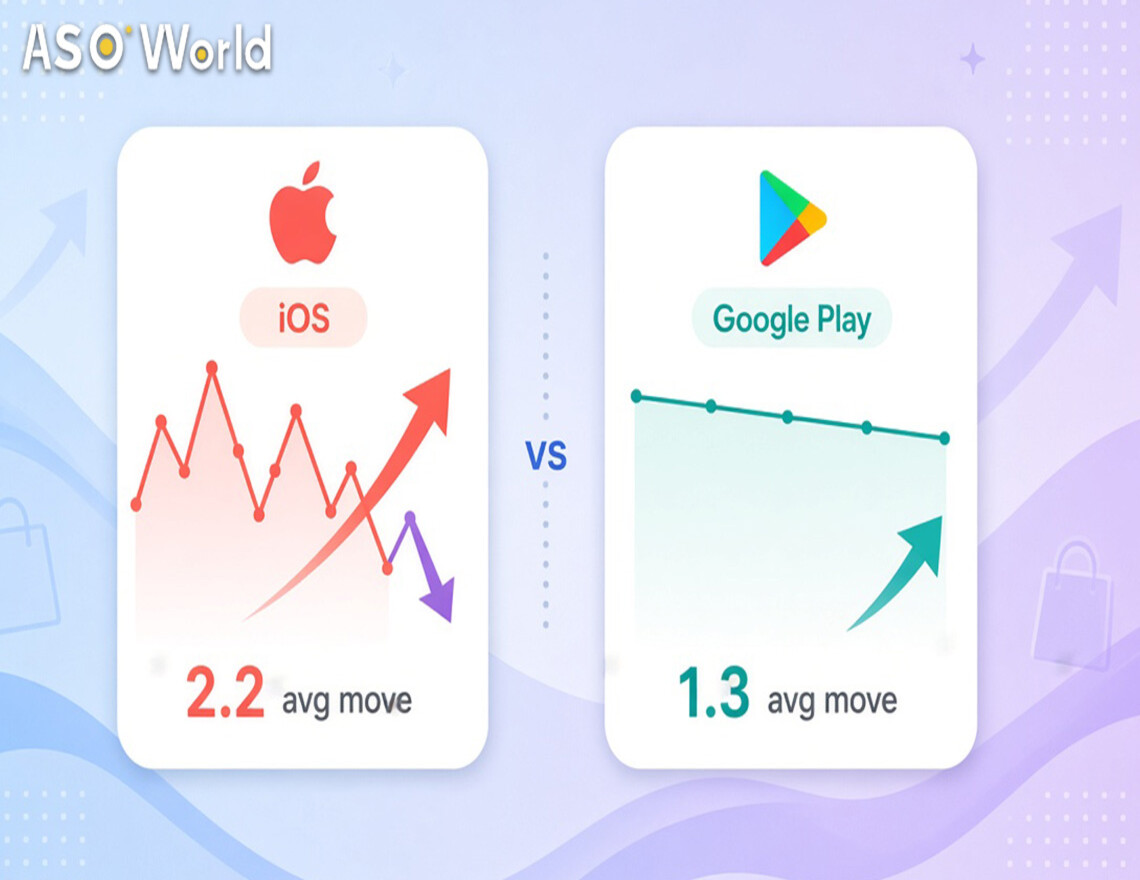
- iOS ranks moved 1.7× more than Google Play day to day around Black Friday 2025 (2.2 vs 1.3 positions).
Market figures are FoxData estimates from our companion articles (keyword timing, release cadence, iOS vs Google Play stability). Prices are from ASOWorld’s pages, verified 30 October 2026.
Every Black Friday plan eventually becomes a budget question: what can this amount of money actually move? This playbook pulls the data from our three companion analyses into one decision per budget tier, with the cost math shown.
The window: six dates that matter more than Black Friday
Black Friday 2026 is Friday, 27 November, but the 2025 data says the window is wider and earlier than the day itself:
| Date (2026) | Milestone | What the data says |
|---|---|---|
| 31 Oct (T-27) | Infrastructure release | Lowe’s and Target shipped feature and redesign updates on 27–28 October |
| 13 Nov (T-14) | Metadata swap + In-App Event live | Head term already hot in US/UK/FR; In-App Events can be promoted 14 days ahead |
| 20 Nov (T-7) | Velocity floor in place | 2025 EU demand peaked 23–24 November, before the node |
| 23–24 Nov | EU peak window | Temu +62% UK and +44% Germany on these days in 2025 (est.) |
| 27–30 Nov | The node + weekend | US retailer spike day (Lowe’s 4.8× baseline, 2025 est.) |
| 1–5 Dec | Cyber Week | Shop held 4.7× baseline on Google Play after Black Friday 2025 (est.) |
Source: companion analyses of FoxData downloads, ranks and keywords (2025 node window; October 2026 snapshots); Apple In-App Events documentation
Allow for review time: Apple’s stated goal is to review 90% of App Store submissions within 48 hours, and Google Play says some reviews can take up to seven days. Every date above is a live date, so submit earlier.
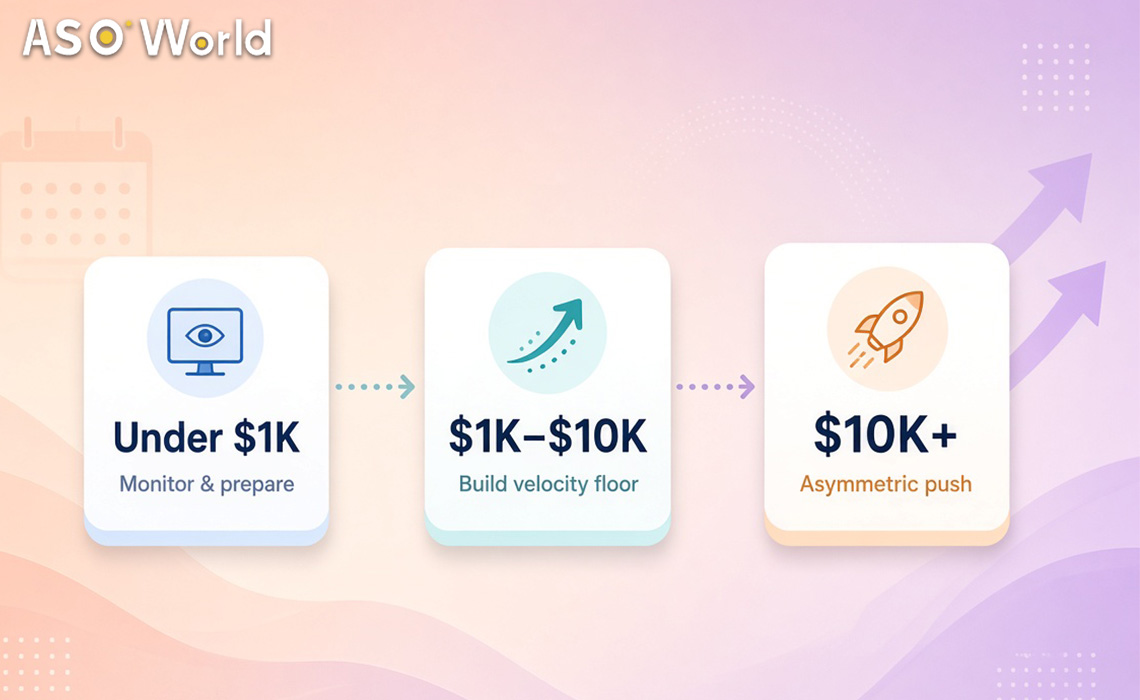
What this means for your app: the calendar is the same at every budget; only the depth changes. The tiers below are built around what each budget can realistically move: metadata (nearly free), keyword positions (mid) and category positions (top tier).
Tier 1: under $1,000 – win the metadata race
At this budget you can’t buy position, but you can control most of what feeds it, and in six of nine tracked markets the seasonal keyword space is still at the floor. Five actions, in order:
- Ship seasonal keywords now for the US/UK/France (head term at 56/45/44) and prepare localised sets for Germany, Japan, Korea and Brazil to ship as their scores lift off 5.
- Create a Black Friday In-App Event (iOS). Event cards can appear in search results and can be promoted up to 14 days before the start date.
- Update promotional text daily in the node window. It sits at the top of your iOS product page and can be changed without a new version or review.
- Fix the rating wall. Reply to every negative review from the last 90 days. Rating momentum is the cheapest stabiliser on volatile iOS charts.
- Monitor daily from 17 November. iOS ranks jumped 5+ positions on 14% of days in the 2025 window; you need to know the same day.
What this means for your app: Tier 1 work keeps paying after the spike ends. Metadata, events and ratings stay in place; burst traffic doesn’t.
Tier 2: $1,000–$10,000 – own keyword positions, not category charts
With four figures you can hold keyword positions through the window. US Shopping category charts are a different scale, as the cost check below shows.
| Goal | 2025–2026 evidence (est.) | Realistic budget |
|---|---|---|
| Top-5 rankings on 10–15 seasonal and long-tail keywords (iOS) | Long-tails like “black friday deals” still at 5/100 on 30 October | Tier 2 |
| Category top-25 in a smaller market or less contested category | Top-25 thresholds scale with market size | Tier 2–3 |
| Hold US iOS Shopping top-25 through the node | #24 baseline ≃ 61K downloads/week (October 2026) | Tier 3 |
| BF-week US iOS Shopping top-10 cameo | Median ~43,300 downloads on the day | Tier 3+ |
Source: FoxData estimates (see companion stability piece); budget mapping based on ASOWorld list prices verified 30 October 2026
The core discipline is phase, don’t spike. Install velocity spread across 13–27 November, with a reserve for each market’s local peak (23–24 November for the EU, 27 November for the US), beats the same budget spent flat or all on the day. Keyword installs start at $0.30 per install on iOS and $0.20 on Android, and require your app to already appear in the top 250 results for each keyword. If your app is stuck far below the band you’re targeting, run a badly ranked or not ranked diagnostic first; the fix is often metadata or rating, not volume.
What this means for your app: a realistic 2026 Tier 2 outcome is a set of seasonal keyword positions that convert deal-intent searches, held through Cyber Week, not a category-chart cameo.
Tier 3: $10,000+ – run both stores asymmetrically
Top-tier budgets fail when they spend the same way on stores that behave differently:
- iOS = surge. More volatile (2.2 positions a day on average, max 33), fast to reward and fast to decay. Concentrate spend on 24–28 November with package installs for position (currently from $0.24 per iOS install and $0.12 on Android, discounted from $0.30 and $0.15) and keyword installs for coverage, coordinated with Apple Search Ads on the head term. Write the 1 December retention plan before the surge starts.
- Google Play = sustain. Calmer (1.3 positions a day), with fewer new top-10 entrants (2 of 10 slots turned over vs 4 on iOS), but gains persisted: 7 of 10 BF-day members were still top 10 a week later. Spend for steady installs through 5 December, not a one-day punch.
- Both = cadence. One or two extra releases in the node window refresh creative and copy.
Scope Tier 3 as one programme with two store calendars rather than one blended campaign. ASOWorld’s app promotion services cover keyword installs, package installs, reviews and custom solutions under one plan.
What this means for your app: at Tier 3 the question isn’t “can I chart?” but “will I still be charting on Cyber Monday?” Design the exit before the entrance.
Worked example: what the numbers actually cost
Say your app sits around #40 on the US iOS Shopping chart with organic downloads near 8,000 a week.
Option A, hold a US Shopping top-25 seat (Tier 3 reality check). The current top-25 line is about 61,000 downloads a week (#24, 23–29 October 2026, FoxData estimate), a gap of roughly 53,000 a week. Over the 13 November–5 December window (about 3.3 weeks), that’s roughly 175,000 additional installs: about $42,000 at the current $0.24 iOS package install price, or ~$52,500 at the $0.30 list price. It also means running at about 7–8× your normal weekly volume, exactly the kind of pattern that store anti-fraud systems flag. For an app at this organic scale, Option A isn’t a sound target.
Option B, own seasonal keywords (Tier 2). Pick 12 seasonal and long-tail keywords where the app already ranks in the top 250. Plan about 600 keyword installs a day in total (roughly half your current daily organic volume, so the pattern stays proportionate), phased as below:
| Phase | Dates (2026) | Share of installs | Why |
|---|---|---|---|
| Ramp | 13–20 Nov | ~35% | indexing lead time; EU demand already climbing |
| EU peak | 20–24 Nov | ~25% | UK/DE/FR demand peaked 23–24 November in 2025 |
| US node | 25–28 Nov | ~30% | the day itself, where retailer spikes land |
| Cyber hold | 29 Nov–1 Dec | ~10% | decay control into Cyber Week |
Source: sizing based on FoxData estimates cited in this series; shares are an ASOWorld planning heuristic, not a store rule; prices verified 30 October 2026
That’s about 11,400 keyword installs over 19 days, roughly $3,400 on iOS at $0.30. The installs needed per keyword vary with competition, so re-check rankings every 3–4 days and move budget from keywords that stall to keywords that move.
Two caveats. Thresholds move: re-pull baselines the week you launch. And velocity only converts if the page converts. The same installs against a weak product page return a fraction of the rank effect, which is why the conversion check comes before the spend check below.
What this means for your app: Tier 2 isn’t “buy installs.” It’s buying a shaped curve, matched to the demand calendar and sized against positions you can actually hold.
Cross-tier: four mistakes to avoid in 2026
- Anchoring everything to 27 November. EU demand peaked 4–5 days early in 2025, and Japan barely moved. Match each market’s curve.
- Shipping seasonal metadata for the first time in the node week. App Review takes time and the head term was already at 56/45/44 a month out.
- Treating iOS and Google Play as one campaign. Different volatility, different entry rates, different decay.
- Buying position before fixing conversion. A top-10 seat above a wall of negative reviews and stale screenshots is rented traffic. Conversion diagnosis comes before spend.
For a week-by-week execution checklist, see our Black Friday ASO timeline. The data behind this playbook is in the companion pieces on keyword timing by country, the metadata release calendar and iOS vs Google Play ranking stability.
FAQ
How much budget do I need to affect my Black Friday ranking?
Under $1,000 moves metadata, events and ratings. $1,000–$10,000 can hold top-5 positions on a set of seasonal keywords. Holding a US iOS Shopping top-25 seat through the window costs roughly $42,000–$52,000 at current list prices for an app with ~8,000 weekly organic downloads.
When should I start if Black Friday is 27 November 2026?
Infrastructure release by 31 October, metadata swap and In-App Event live by 13 November, keyword velocity in place by 20 November. In 2025, UK, German and French demand peaked 23–24 November, before the node.
Is Black Friday worth it outside the US?
Yes, with different timing. The US is the spike market (Lowe’s 4.8× baseline on the day, 2025 est.), but UK/German/French demand peaked earlier and six of nine markets’ English keywords still sat at 5/100 on 30 October, so localised, early campaigns face little competition.
Should I run the same campaign on iOS and Google Play?
No. iOS moved 1.7× more day to day and decayed faster after the node; Google Play was calmer and stickier (7 of 10 BF-day top-10 apps held through 5 December 2025). Surge iOS, sustain Google Play.
What did top apps do in October 2026?
Deal-native apps shipped constantly: Temu released 9 times on Google Play and 8 on the App Store. Amazon released once on Google Play. As of 30 October, none had added Black Friday wording to update notes.
Do you guarantee a top-10 Black Friday rank?
No, and be sceptical of anyone who promises one. Thresholds shift with market volume (2025’s iOS median: ~43,300 downloads on the day, est.) and vary by category, country and date. The data supports a disciplined plan, not a guaranteed outcome.