COVID-19 UPDATE


Key numbers
- In October 2026, Temu shipped 9 releases on Google Play and 8 on the App Store, roughly one every 3–4 days, and Walmart matched it at 9/8 (FoxData version records, US).
- Amazon shipped 1 Google Play release in October, and Best Buy 2. The biggest brands ship less, not more, heading into the node.
- 4 of 7 tracked iOS apps shipped five or more releases in October; on Google Play it was 3 of 11. The App Store set updated faster.
- As of 30 October, none of the tracked apps mention “Black Friday” in their What’s New notes. The seasonal copy race hasn’t started yet.
- App Store In-App Events can be promoted up to 14 days before they start and appear in search results (Apple). For Black Friday on 27 November, that promotion window opens on 13 November.
Release figures come from FoxData version records (release dates and public What’s New text), 2 August–30 October 2026, US storefronts; counts use unique release dates. Store-feature facts come from Apple and Google documentation.
This piece looks at when the top US shopping apps ship, what their update notes say four weeks out, and which store features show seasonal messaging without a full metadata cycle.
The cadence gap: deal-native apps vs brand retailers
We pulled the full retrievable release history (about 90 days) for the top US shopping apps on both stores and counted releases per month:
| App | Google Play Aug / Sep / Oct | App Store Aug / Sep / Oct |
|---|---|---|
| Temu | 11 / 12 / 9 | 8 / 8 / 8 |
| Walmart | 11 / 7 / 9 | 11 / 6 / 8 |
| AliExpress | 4 / 3 / 6 | – |
| SHEIN | 4 / 4 / 3 | 4 / 5 / 7 |
| Target | 4 / 4 / 4 | 5 / 5 / 5 |
| Lowe’s | 3 / 6 / 4 | 4 / 8 / 4 |
| Etsy | 5 / 4 / 4 | – |
| Old Navy | 2 / 2 / 3 | 3 / 3 / 3 |
| Capital One Shopping | 1 / 2 / 2 | – |
| Best Buy | 3 / 1 / 2 | 2 / 1 / 3 |
| Amazon | 1 / 2 / 1 | – |
Source: FoxData version records, US storefronts | 2 August–30 October 2026 | unique release dates | “–” = not tracked on that store; eBay’s Google Play record was empty and is excluded.
The split is clear. Temu and Walmart shipped roughly every 3–4 days in October on both stores, and AliExpress (Google Play) and SHEIN (App Store) also stepped up. Amazon, Best Buy and Capital One Shopping shipped once or twice in the month and did not accelerate. Temu’s October Google Play cadence was nine times Amazon’s.
Amazon doesn’t need cadence; its brand demand carries it. For everyone else, each release is a chance to refresh screenshots, What’s New and metadata. Neither Apple nor Google lists update frequency as a ranking factor, so treat it as an enabler, not a hack.
What this means for your app: if your last update shipped in September, you have fewer opportunities to change what users see during the season than the apps you compete with. Plan your release slots now.
What the update notes say (and don’t)
In late October 2026, the update notes tell a consistent story: nobody has started the seasonal play yet. Temu’s App Store notes use an evergreen template, Walmart’s are a courtesy note, and Best Buy’s are bug-fix boilerplate. None of the tracked apps mention Black Friday.
The exceptions are instructive. Lowe’s used its 28 October App Store update to headline platform work, including support for iPhone Duo (Apple’s first foldable iPhone, on sale from 23 October 2026), iOS 27 and Siri. Target’s 27 October note teased “a fresh new look throughout the app.” Both are capability and conversion moves positioned four weeks out, before seasonal search volume exists.
One caveat: our source doesn’t expose the history of title, subtitle or keyword-field edits, so title-level guidance below is practice guidance, not measured fact.
What this means for your app: ship the infrastructure release now (like Lowe’s) and save the seasonal wording for when volume arrives. Per our companion analysis, the head term was already at 56/45/44 in the US/UK/France on 30 October.
The store features that actually show seasonal messaging
What’s New appears on your product page and in the Updates list, not in search results. Other assets do more of the seasonal work, under different rules:
| Asset | Where users see it | Needs a new app version? | Indexed for search? | Seasonal use |
|---|---|---|---|---|
| Title / subtitle / keyword field (iOS) | Search results, product page | Yes, plus App Review | Yes | Seasonal head terms in markets where popularity has lifted |
| Promotional text (iOS, 170 chars) | Top of product page | No, edit anytime | No | Swap deal messaging daily without review |
| In-App Events (iOS) | Search results, product page, Today/Games/Apps tabs | No new build; the event is reviewed | Event name and short description reported as indexed | “Black Friday Deals Week” event card, promoted 14 days ahead |
| What’s New | Product page, Updates list | Yes | No | Deal-phase copy for existing users |
| Short / full description (Google Play) | Listing, search snippet | No new build; listing change is reviewed | Yes (Google Play) | Seasonal terms in the short description |
| Promotional content (Google Play) | Store surfaces, listing | No new build | Varies | Black Friday offer card |
Source: Apple Developer (In-App Events, App Store Connect), Play Console Help | indexing of In-App Events metadata per third-party ASO platform observations | checked 30 October 2026.
In-App Events are the most underused asset here. According to Apple, an event can run up to 31 days and be promoted up to 14 days before its start date, and event cards appear in search results as well as on your product page. The event name is limited to 30 characters. For a Black Friday 2026 event starting 20 November (the European peak window), the promotion window opens 6 November.
What this means for your app: your seasonal message doesn’t have to wait for a version update. Use promotional text and In-App Events for the deal message; reserve title and subtitle changes for keyword targeting.
A three-deadline calendar for 2026
Working back from Black Friday, 27 November 2026, and allowing for review times, the observed behaviour of top apps supports three deadlines. Apple’s App Review Help page sets a goal of reviewing 50% of submissions within 24 hours and 90% within 48 hours. Google Play says some apps may face reviews of up to seven days or longer. Google’s managed publishing lets you get changes approved early and choose exactly when they go live.
T-27 (by 31 October): the infrastructure release.
Crash fixes, platform features, refreshed screenshots, product page tests. This is what Lowe’s and Target did in late October.
T-14 (by 13 November): the metadata and event swap.
Seasonal terms into the title, subtitle and keyword field for markets whose popularity has lifted (US/UK/France already; others as they rise above 5). Submit your In-App Event so it’s promoted through the window. Rewrite What’s New for deal hunters. On Google Play, submit listing changes early with managed publishing on, then publish on your chosen day.
T-3 (by 24 November): the cadence window.
Temu’s every-3–4-days pattern is the extreme end; for most apps, one or two extra releases between 17 and 27 November are enough. Submit each at least two days before it needs to be live.
Source: deadline logic derived from FoxData release records (2 August–30 October 2026, US) and 2025 demand curves in our companion keyword-timing article; review times per Apple App Review Help and Play Console Help
What this means for your app:
the T-14 metadata swap is the highest-leverage single action here, because it is the only one that changes what you rank for rather than how you convert.
What a node-window What’s New should say
Since the observed top apps haven’t written seasonal copy yet, here are three templates for the T-14 and T-3 releases:
- Early-access frame (T-14): lead with the benefit window, not the feature, e.g. “Black Friday deals land here first: turn on alerts.” AliExpress’s October notes show a strong shopping-relevant feature line (“Choice” items with better prices and services) rather than boilerplate.
- Doorbuster frame (T-3): urgency plus utility. Say what’s discounted, until when, and how the app helps users act (wallet, pickup, live inventory).
- Cyber-extension frame (1 December): the 2025 curves justify a third beat. SHEIN’s Google Play downloads peaked at an estimated ~49,300 on 3 December, after Black Friday, and Shop’s US Play downloads ramped to 4.7× baseline by 3 December. Tell users the window extends past the weekend.
| App (US) | Last release before 30 October 2026 | Note character |
|---|---|---|
| Lowe’s (iOS) | 28 October | platform-feature story |
| Target (iOS) | 27 October | redesign tease |
| Temu (iOS / GP) | 30 October / 29 October | evergreen template |
| Amazon (GP) | 14 October | evergreen boilerplate |
| Best Buy (iOS / GP) | 28 October / 26 October | bug-fix boilerplate |
Source: FoxData version records, US storefronts | retrieved 30 October 2026.
Pair the copy with your rating: a deal-aware note above fresh one-star reviews undermines itself. Reply to checkout or delivery complaints before the node; a structured approach to app reputation and negative review management helps you prioritise which complaints to fix first.
What this means for your app: What’s New is a free asset you rewrite at every release. The top apps leave it as boilerplate, which is why a deal-aware note stands out in the node window.
Playbook: what to do next, by budget
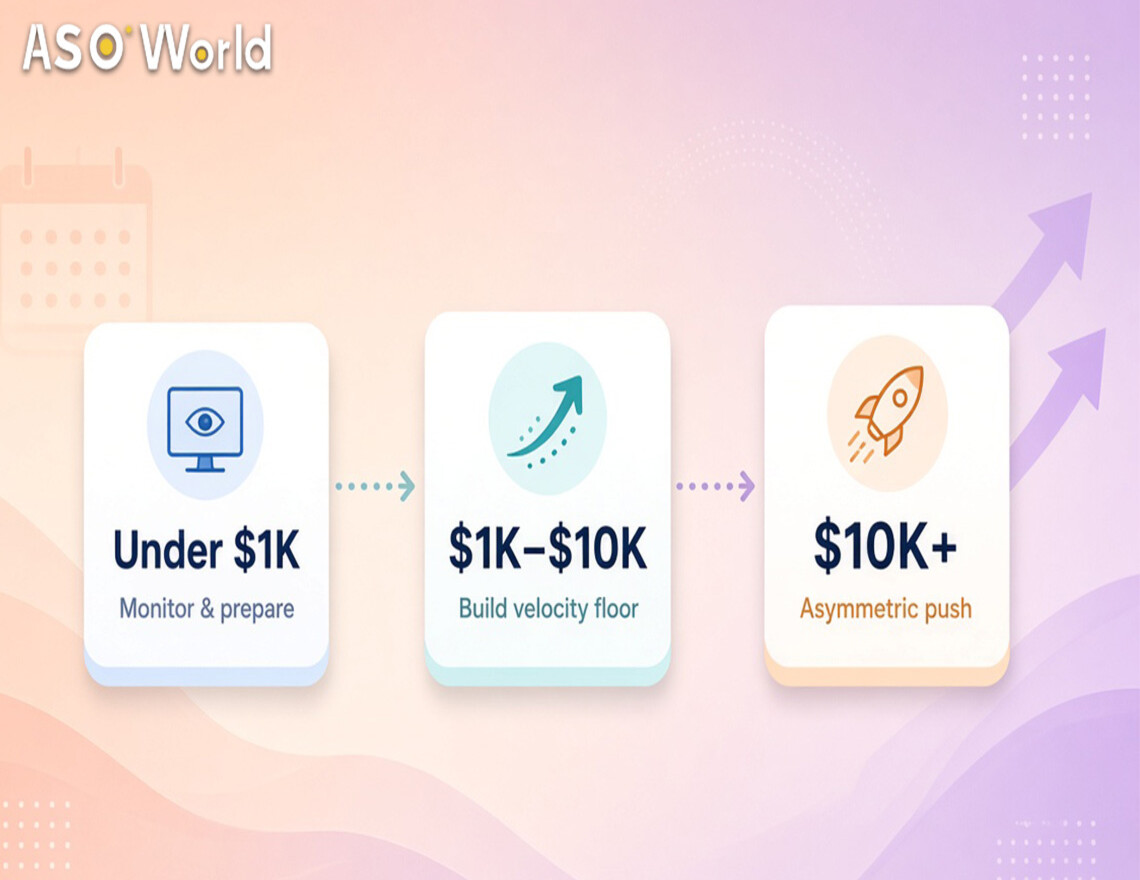
Tier 1 – under $1,000.
Do the T-14 work yourself: seasonal head terms for the US/UK/France, one localised market, a Black Friday In-App Event, daily promotional text and a What’s New rewrite.
Tier 2 – $1,000–$10,000.
Add the T-3 releases with What’s New copy for each deal phase, plus custom product pages or store listing experiments for the seasonal creative. Metadata and conversion assets together are the core of an App Store Optimisation service engagement. Check that seasonal traffic converts: conversion-rate diagnosis comes before any paid push.
Tier 3 – $10,000+.
Run the full calendar: infrastructure release now, market-staggered metadata swaps, events per country and custom store listings so the seasonal creative matches each market’s actual peak week. For shopping and marketplace apps, ASOWorld’s ecommerce app marketing programme bundles these into one seasonal plan.
For the keyword side, see When do Black Friday keywords start climbing?. For sizing spend, see the Black Friday ASO budget playbook.
FAQ
How many updates do top shopping apps ship before Black Friday?
In October 2026, Temu shipped 9 on Google Play and 8 on the App Store, Walmart 9 and 8, and SHEIN 7 on the App Store. Amazon (1 on Google Play) and Best Buy (2) shipped far fewer (FoxData version records, US).
Do top apps mention “Black Friday” in their update notes already?
Not as of 30 October 2026. None of the 11 Google Play and 7 App Store apps we tracked did. Being early on infrastructure and late on seasonal wording is the observed pattern.
Does updating my app help ASO?
Indirectly. A release lets you change metadata, screenshots and copy, and keeps your app current on new devices. Neither store lists update frequency as a ranking factor, so an update with unchanged metadata changes little.
How long does App Store review take before Black Friday?
Apple’s App Review Help page states a goal of reviewing 50% of submissions within 24 hours and 90% within 48 hours. Plan at least two days of buffer for any metadata change.
What is the fastest way to show Black Friday messaging on the App Store?
Promotional text (170 characters) can be changed anytime without a new version. In-App Events can be promoted up to 14 days before they start and appear in search results.