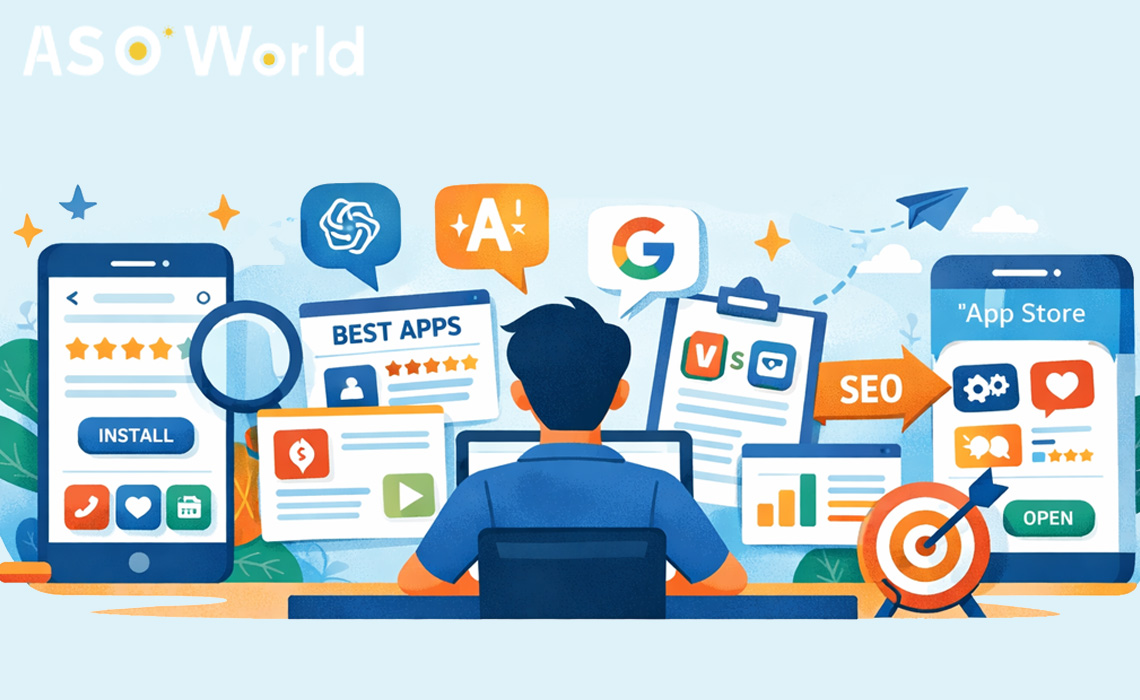
For years, mobile growth has revolved around the same control panels: App Store Connect and Google Play Console. Rankings, metadata, screenshots, conversion rates. The assumption was simple: discovery starts inside the store.
That assumption is quietly shifting.
When users look for a "habit tracker for ADHD" or the "best budgeting app for couples," many now begin somewhere else. Queries are increasingly resolved through tools like OpenAI's ChatGPT, Perplexity AI, or Google's AI Overviews. In these environments, answers are synthesized before a user ever opens an app store.
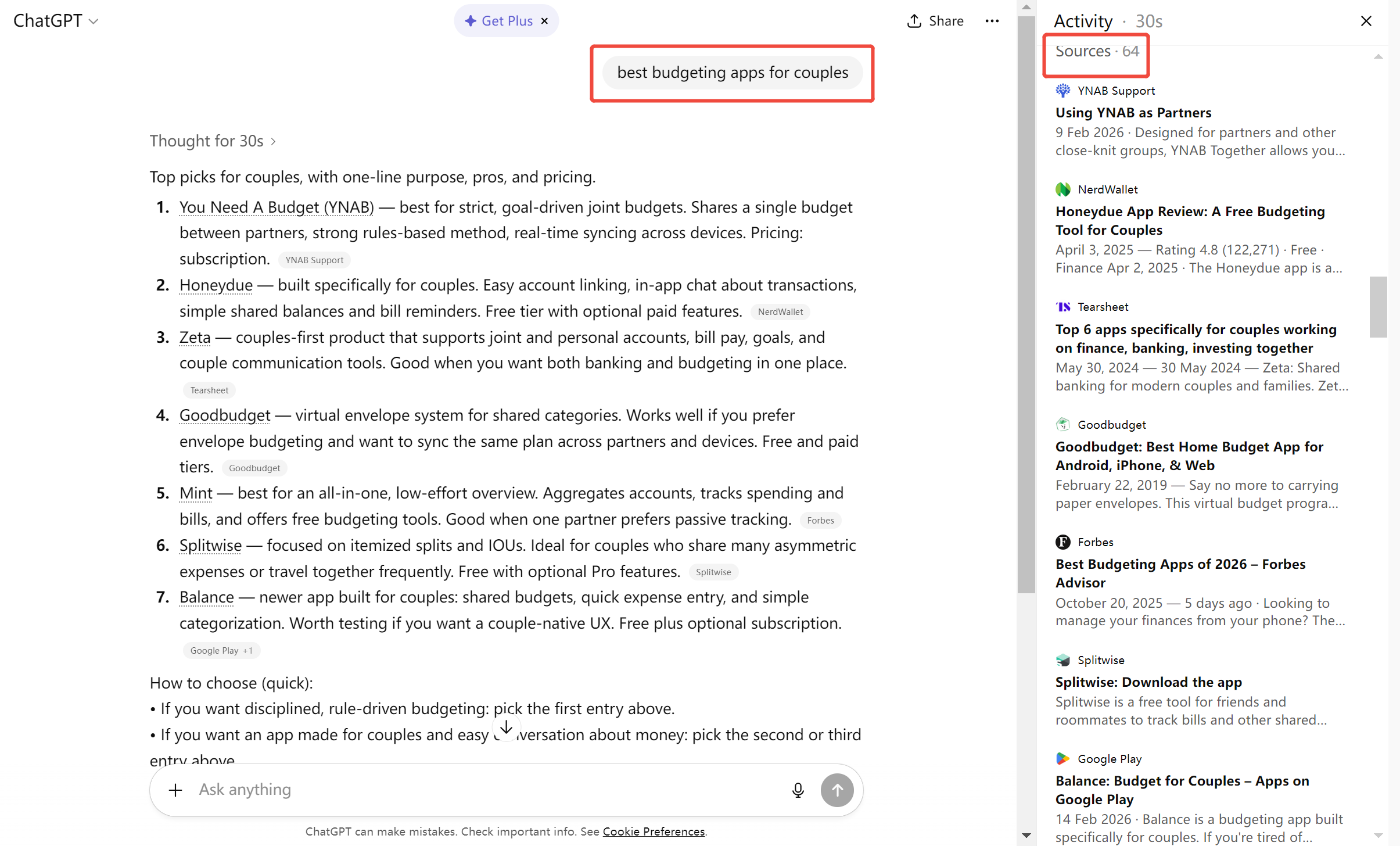
And the sources behind those answers are rarely store listings. They are web pages: comparison guides, in-depth reviews, category explainers, and long-form editorial content.
AI-driven discovery often happens before store discovery.
In this article, we explore:
- Is app discovery quietly shifting outside the app store ecosystem?
- Why do AI systems cite web content more often than app store listings?
- What makes certain apps more “referenceable” in AI-generated answers?
- How should growth teams rethink the relationship between SEO and ASO?
- What does this structural shift mean for long-term organic acquisition?
Why App Store Pages Are Not the Primary AI Source
This shift is structural, not incidental.
Large language models are trained on and retrieve from vast portions of the open web. Their responses increasingly rely on retrieval systems that prioritize crawlable, indexable documents. App store listings, while structured, offer limited contextual depth and are not optimized for broad semantic retrieval.
More importantly, AI systems are asked to justify recommendations. A query like “best meditation apps for beginners” requires:
- Comparative framing
- Use case clarification
- Pricing nuance
- Pros and cons
- Target audience segmentation
Store pages are designed for conversion, not analysis. Web articles, by contrast, are designed for explanation. That distinction matters.
If an app does not maintain a substantive web presence, it reduces the probability of being included in the source pool AI systems draw from.
Content as a Discovery Asset
This does not signal the end of ASO. It signals an expansion of the discovery surface.
Apps that consistently publish:
- Category-level guides
- Comparative analyses
- Use case–specific resources
- Industry explainers
tend to create a broader semantic footprint. These documents become eligible for citation, summarization, and reference in AI-generated answers.
Each high-quality page increases the statistical likelihood of appearing in pre-store discovery. Over time, this compounds.
For a deeper structural breakdown of how app-focused SEO can expand reach beyond store environments, we explored the topic in App SEO Mastery: How to Expand Organic Reach Beyond App Stores .
Why ASO Still Matters More Than Ever
Discovery may begin outside the store, but installation still happens inside it.
When a user clicks through from an article or AI-generated answer, they arrive at the product page in the App Store or Google Play. At that point, traditional ASO elements determine conversion:
- Title and keyword alignment
- Visual presentation
- Social proof and ratings
- Review velocity
- Localization depth
SEO drives eligibility and awareness.
ASO captures intent and converts it.
They are no longer parallel disciplines. They are sequential stages in a single acquisition path.
What This Means for App Growth Teams
User acquisition costs continue to rise. Paid traffic remains volatile. AI-mediated answers are becoming a persistent entry point in the research phase.
In this environment, relying exclusively on store optimization narrows the funnel. Building structured, indexable web content expands it.
For growth teams evaluating their long-term discovery mix, the question is no longer whether SEO is relevant to apps. The question is how integrated the strategy should be.
At ASOWorld , our work has historically focused on optimizing the final conversion layer through ASO. Increasingly, we are helping teams architect the upstream layer as well, ensuring that web visibility and store performance reinforce one another.
AI systems will continue to reshape how products are surfaced. Apps that treat web presence as a core growth asset, not an afterthought, are better positioned to remain visible across both search and synthesis environments.
 COVID-19 UPDATE