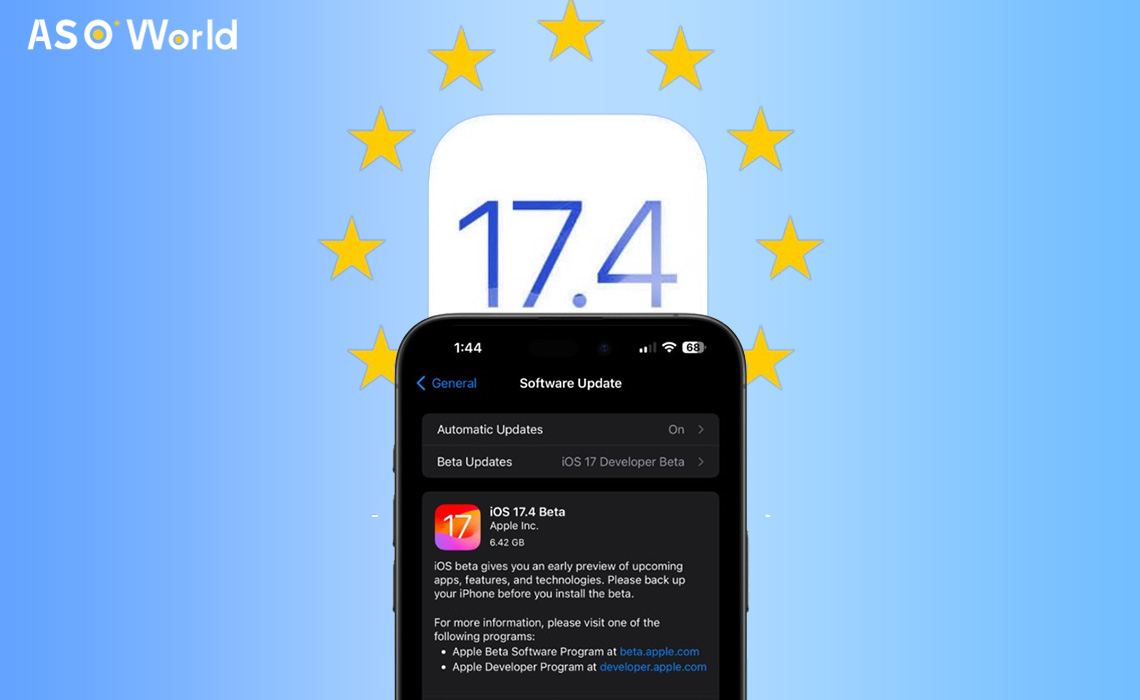
The initial rollout of the iOS 17.4 beta marked a significant shift in Apple's operational framework. This update introduces substantial structural modifications, primarily designed as compliance mechanisms for the European Union's Digital Markets Act (DMA) affecting the App Store landscape. Concurrently, it deploys several systemic adjustments for the global user base and developer community.
The following is an objective analysis of the core components and strategic implications of iOS 17.4.
Overhauling the App Store: EU-centric Compliance
iOS 17.4 implements critical infrastructure changes to the App Store and the broader iOS ecosystem, specifically targeting iPhone users within the European Union. These adjustments introduce support for third-party application marketplaces, alter default web browser protocols, and permit game streaming applications. For application developers and publishing teams, these changes necessitate an immediate review of distribution and user acquisition strategies to remain competitive in the European market.
※ Related Reading - Navigating iOS & App Store Regulatory Adjustments in the EU
Expanded Payment Flexibility and Financial Structures
Diversified Payment Integration
Apple has modified its financial guidelines to permit the integration of alternative payment gateways within native applications. This structural move eliminates the previous mandate requiring developers to solely utilise Apple's proprietary in-app purchase system. Developers opting for alternative payment methods while distributing via the official App Store will receive a standard 3% reduction on the usual commission rates.
For publishers choosing to distribute applications through third-party marketplaces whilst utilising alternative payment systems, Apple imposes a Core Technology Fee of €0.50 per first annual install per user.
Strategy Note: Financial and marketing teams must conduct rigorous margin analysis to determine whether remaining within Apple’s standard 15/30% commission framework or adopting the alternative fee structure (and bearing the €0.50 tax) yields a higher return on investment (ROI). Transactions must be routed through industry-recognised, secure payment service providers.
Browser Engine Autonomy in the EU
Following the installation of iOS 17.4, users in the European Union are prompted with a selection interface upon initially launching Safari, requiring them to choose a default web browser from a randomised list of the most utilised iOS alternatives.
Furthermore, Apple has ceased its mandate requiring third-party browsers (such as Google Chrome or Mozilla Firefox) to exclusively utilise its WebKit engine. Alternative browser engines are now supported on iOS, allowing developers to deploy native rendering technologies.
Expanded NFC Capabilities for Financial Apps
The update grants third-party payment applications and banking institutions direct access to the iPhone's NFC component within the European Economic Area. This enables fintech developers to facilitate contactless transactions independently of Apple Pay or the native Wallet app. Users can designate an alternative contactless payment provider to execute transactions at tap-to-pay terminals or via the physical Side button double-click mechanism.
Actionable Detail: Financial application developers should aggressively optimise their user onboarding funnels to encourage users to set their application as the default NFC provider, leveraging in-app prompts and educational ToolTips.
Revised Policies for Gaming Applications
Apple has reversed its previous policy constraints, now permitting cloud gaming and streaming applications to be hosted globally on the official App Store. This adjustment removes the requirement for platforms like Xbox Cloud Gaming and Nvidia GeForce NOW to operate exclusively via web-based workarounds, allowing them to function as native iOS and iPadOS applications.
Strategy Note: Cloud gaming providers should immediately focus on App Store Optimisation (ASO) strategies—optimising metadata, keywords, and screenshots—to capture high-intent search traffic previously lost to standard web search.
In-App Purchases for Mini-Apps and Plug-ins
The scope of the native in-app purchase API has been broadened. Mini-applications, casual mini-games, integrated chatbots, and modular plug-ins are now technically permitted to utilise Apple's in-app purchase infrastructure, providing developers with standardised monetisation pathways for diverse application formats.
Metadata and Interface Updates in Podcasts & Music
iOS 17.4 introduces functional modifications to the Apple Podcasts application. A primary inclusion is the automated transcription feature, technically generating and displaying text transcripts for audio content.
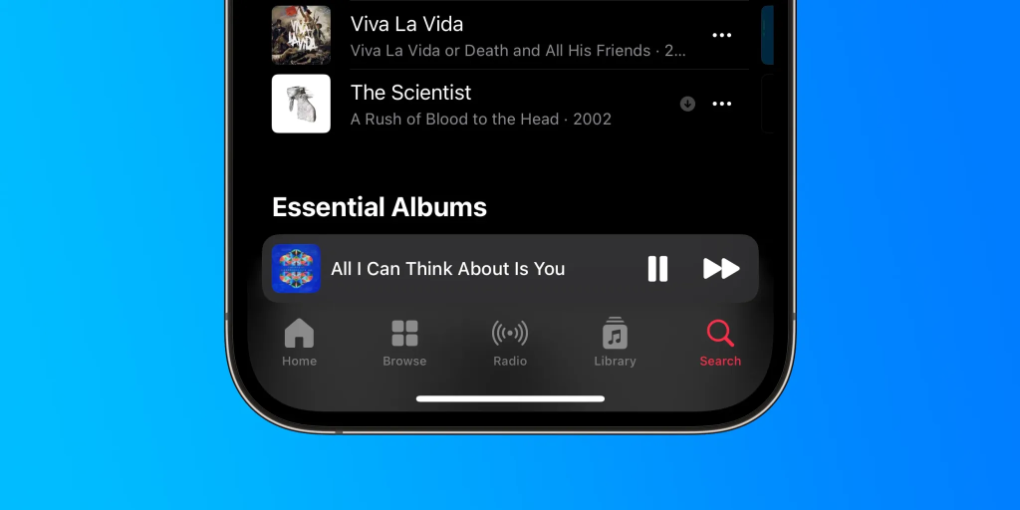
Furthermore, the "Now Playing" interface has been visually aligned with the design language of the Apple Music application.
To standardise navigation terminology, the tab formerly designated as "Listen Now" in the lower navigation bar has been categorically renamed to "Home."
Integration of Unicode 15.1 Emojis
As part of standard character progression, iOS 17.4 natively integrates the Unicode 15.1 emoji set. Additions include:
- A head indicating horizontal movement (shaking)
- A head indicating vertical movement (nodding)
- A mythological phoenix
- A lime
- A brown mushroom
- A broken chain

This update complies with the computational standards approved by the Unicode Consortium in September 2023, expanding the standard communication toolset.
Refined Voice Assistant Mechanics
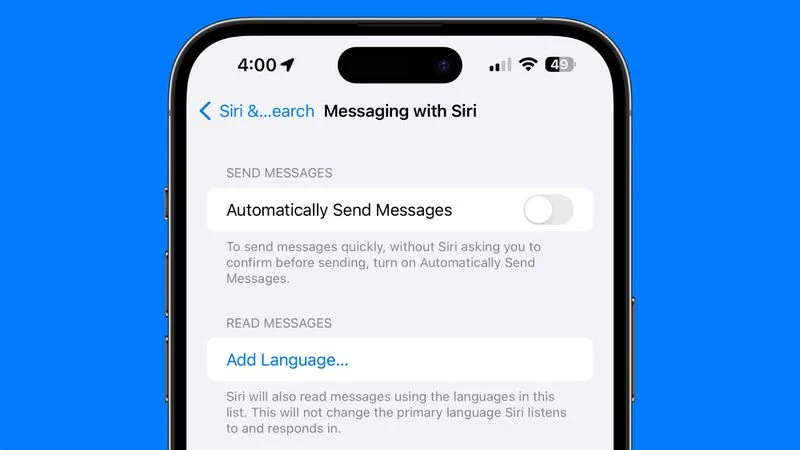
The setting previously categorised as "Automatically Send Messages" within the system preferences has been reclassified to "Messaging with Siri." This terminology adjustment provides a more accurate reflection of the assistant's operational scope.
Additionally, users are now provided with the configuration option to designate a specific language for the voice assistant to utilise when dictating incoming messages, separated from the primary system language. Supported linguistic models include Spanish, French, German, and Mandarin Chinese.
Granular Stolen Device Protection Configurations
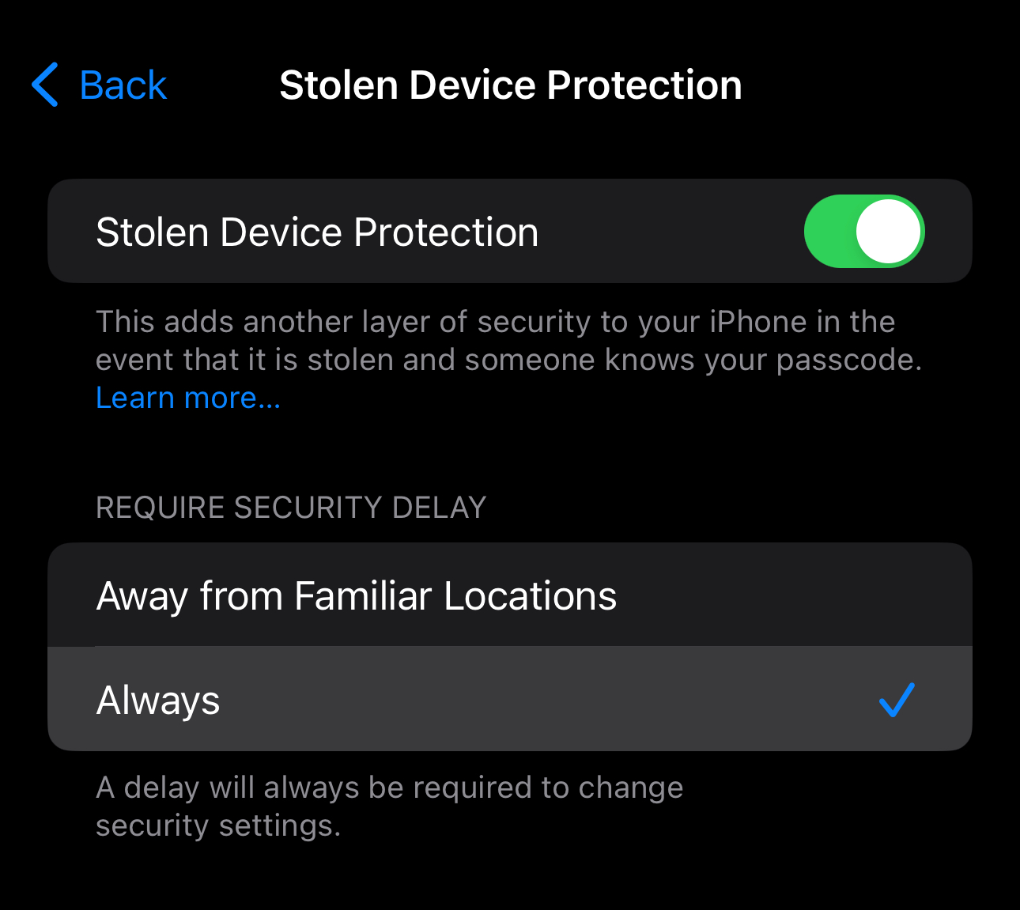
The system's biometric security framework introduces a conditional security delay. Administrators of the device can mathematically govern when this biometric delay applies:
- Always: The algorithmic security delay is strictly enforced during all parameter changes, irrespective of geospatial data.
- When Away from Familiar Locations: The delay protocol relies on location services, executing only when the hardware is outside areas statistically categorised by the system as 'familiar' basepoints.
This operational logic allows users to configure the precise risk threshold for their devices.
Automotive Telemetry: Next-Generation CarPlay
Data extrapolated from the iOS 17.4 software reveals foundational code for the next iteration of CarPlay. The system structure references eight distinct applications built to interface directly with vehicle telemetry.
Identified Automotive Applications
- Car Camera: Renders the vehicle's rear-facing camera feed directly within the OS interface.
- Charge: Specific to Electric Vehicles (EVs); accesses battery management systems to display charge cycles, battery health, and load completion estimates.
- Climate: Interfaces with the vehicle's HVAC APIs to control operational temperatures, blower speeds, and heated hardware elements.
- Closures: A systemic monitoring tool that issues alerts regarding unlatched doors or triggered hardware sensors.
- Media: Integrates specific frequency modulations (AM/FM) and potentially SiriusXM directly into the system's central nervous system.
- Tyre Pressure: Taps into hardware sensors to display PSI/Bar metrics per tyre and issues calculated deflation warnings.
- Trips: A data-logging tool charting average velocity, energy expenditure, trajectory limits, and operational duration.
Additionally, the software beta indicates logic for automated transition screens (e.g., a "Goodbye" protocol) executed when the vehicle's ignition state registers as off.
Safari UI Adjustments
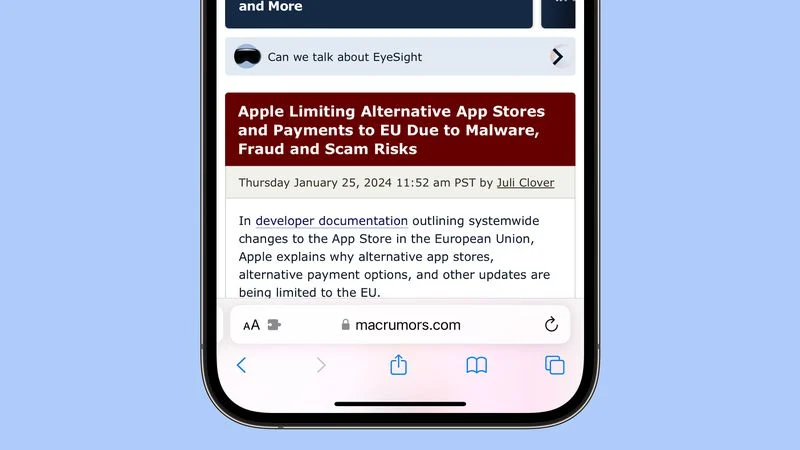
From a Graphical User Interface (GUI) perspective, the navigation address bar within Safari features a mathematically wider operational layout compared to parameters established in version 17.3.
Extended SharePlay Network Controls
System updates to both iOS 17.4 and tvOS 17.4 expand the SharePlay API parameters to include Apple TV and HomePod hardware. This network mapping allows secondary users to manipulate playback states providing they meet the host's security clearance.
Operational Mechanics:
- Networked Control: Approved secondary nodes (guest devices) can send command payloads to the primary audio/visual hardware, altering playback states.
- Asymmetrical Subscriptions: Only the host node requires an active, paid Apple Music subscription status. Guest nodes are granted temporary, tokenised access to the server library without querying their own subscription state.
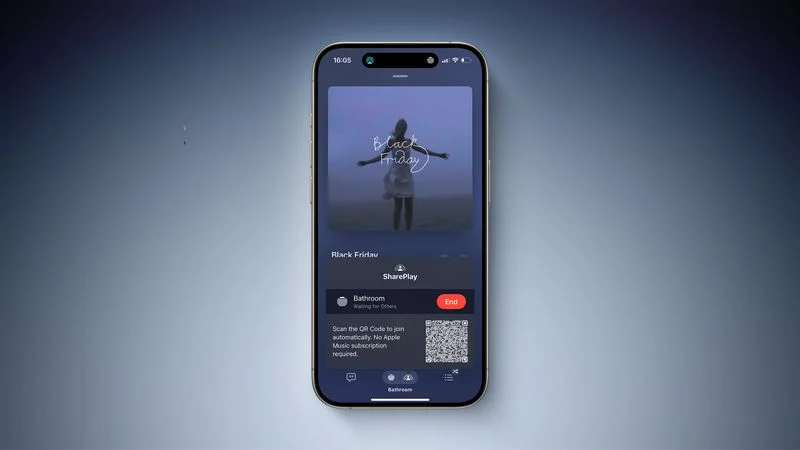
Connection Protocols
- Visual Handshakes (QR): Connection nodes are initiated by generating and scanning a localised QR code on the host's primary display mapping.
- Remote Connectivity: Authentication can occur within local subnets or external nodes, displaying a reliable approach to multi-user input variables.
Objective Conclusion
From an analytical standpoint, iOS 17.4 functions primarily as a requisite compliance measure for the EU regulatory block and functionally restructures how both developers and hardware interact with alternative markets. Development and marketing teams should systematically audit their existing payment gateways, evaluate the mathematical viability of third-party distribution formats, and update their application metadata to leverage newly unblocked capabilities (like cloud gaming and external NFC access).
For industry professionals aiming to adjust to this shifting landscape, prioritising objective data and targeted search behaviour modifications is essential.

Click "Explore ASO Solutions" to structurally optimise your application and gaming portfolios with our professional ASO World mobile app marketing and acquisition integrations today.
 COVID-19 UPDATE