Apple has introduced a new subscription framework that fundamentally restructures how users pay for applications — and how developers monetise them. This technical analysis evaluates what the monthly subscription with a 12-month commitment means for pricing strategy, conversion optimisation, and long-term retention metrics, alongside implementation protocols.
What Did Apple Announce?
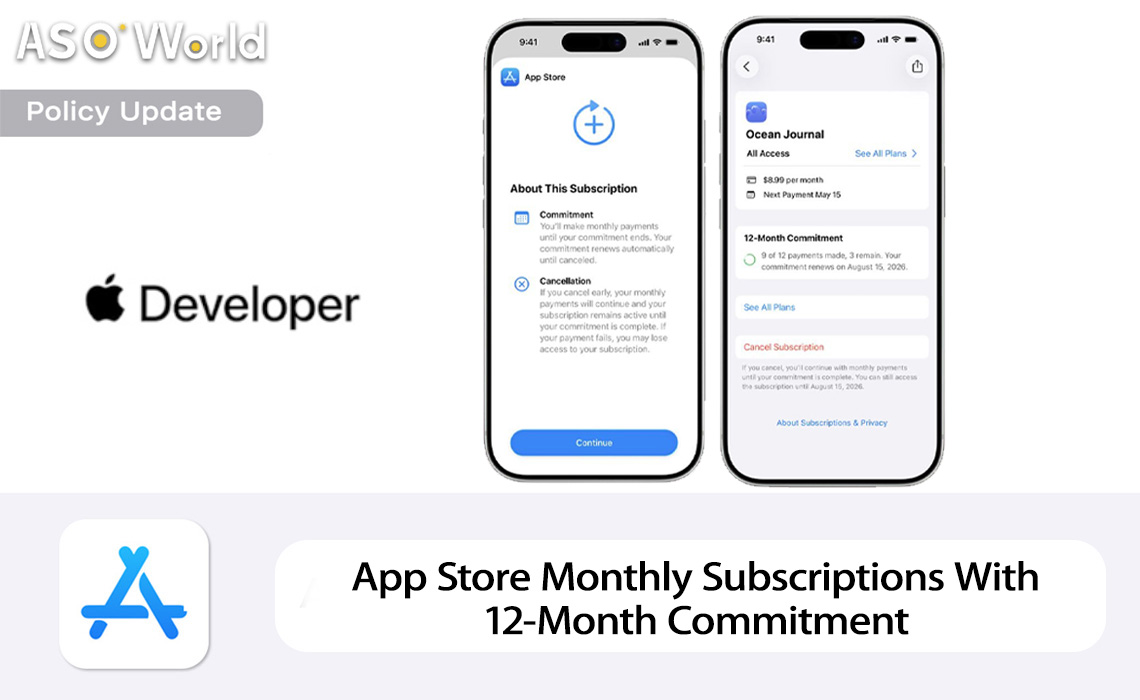
On 27 April 2026, Apple officially deployed a new subscription type within App Store Connect: monthly subscriptions with a 12-month commitment. This model permits developers to offer the discounted annual pricing that users prefer, but billed in smaller, monthly instalments rather than a single upfront transaction.
Key parameters from the announcement:
- Users commit to a 12-month term but pay on a month-by-month basis at a discounted rate (relative to standard monthly pricing).
- Users may cancel at any point; however, this strictly prevents renewal after the completion of their remaining committed payments, rather than stopping immediate billing.
- Apple provides integrated transparency features: users can track completed and remaining payments, alongside receiving automated email and optional push notifications prior to renewals.
- Developers can configure these subscription types via App Store Connect and test them in Xcode immediately; the feature becomes available to users with iOS 26.4 and equivalent OS updates next month.
- Notable exclusion at launch: The United States and Singapore are excluded from the initial rollout, with no confirmed timeline for structural integration in those markets.
For developers and product managers handling subscription-based applications, the strategic implications are substantial. This is not merely a billing update — it is a structural shift in user perception and commitment mechanics.
🔑 KEY TAKEAWAY
This model operates centrally between the flexibility of monthly subscriptions and the revenue predictability of annual plans. For developers, it establishes a third pricing tier that can measurably improve conversion rates — particularly in price-sensitive international markets where the initial capital outlay of an annual plan is a documented barrier to acquisition.
The Economic Psychology Behind Subscription Pricing
Subscription pricing fundamentally balances two competing commercial forces:
- Annual plans yield a higher Lifetime Value (LTV) and lower churn — however, the upfront cost generates considerable friction at the point of purchase. Users frequently hesitate to commit £49.99 or £99.99 immediately, even when the amortised monthly cost is mathematically advantageous.
- Monthly plans mitigate purchase friction — but historically suffer from elevated churn rates and correspondingly lower overall revenue per subscriber.
Apple's 12-month commitment model directly addresses this commercial tension. By enabling users to secure annual-level pricing alongside a monthly payment cadence, it mitigates the psychological resistance to a large upfront fee whilst securing a longer contracted duration.
This is a proven model successfully deployed across sectors such as telecommunications, SaaS, and media streaming (for example, Adobe Creative Cloud's annual plan billed monthly). The integration of this structure natively into the App Store infrastructure indicates an increasing maturation of mobile subscription economics.
Comparative Analysis of Subscription Options
| Subscription Type |
Payment Frequency |
Commitment |
Price per Month |
Churn Risk |
| Standard Monthly |
Monthly |
None |
Highest |
High |
| Monthly with 12-Month Commitment (NEW) |
Monthly |
12 months |
Discounted |
Lower |
| Standard Annual |
Yearly (single payment) |
12 months |
Lowest |
Lowest |
5 Actionable Strategies to Implement This Model
This functionality is available for configuration in App Store Connect today. Below are data-driven strategies for integrating it into your monetisation and operational pipelines.
1. Deploy as a Third Pricing Tier on Your Paywall
The majority of subscription applications currently present a binary choice: monthly and annual. The 12-month commitment plan establishes a logical middle tier. Position it as the "optimal value" choice — providing consumers the monthly payment flexibility they demand alongside substantial savings compared to standard monthly pricing.
💡 EXPERT TIPConduct A/B testing on your paywall comparing three tiers against two. In numerous SaaS environments, introducing a "recommended" middle tier amplifies overall conversion metrics by 10–20% via the
decoy effect — a cognitive bias making the annual plan appear mathematically superior, whilst capturing users who would otherwise default to standard monthly options. Utilise App Store Connect's product page optimisation tools to validate varied UI presentations. For technical parameters on conversion optimisation, consult documentation on
how to leverage custom product pages to increase conversion rates in acquisition funnels.
2. Prioritise Geographic Markets (Launch Availability)
As the U.S. and Singapore are excluded from the initial release, the primary opportunity lies in wider international markets — particularly regions exhibiting higher price elasticity of demand, where the upfront cost of an annual subscription represents a quantifiable conversion barrier.
Teams currently executing localised ASO strategies with keyword optimisation across multiple global storefronts are structurally positioned as early adopters. Couple localised metadata with the new commitment plan to acquire users in markets such as the UK, Brazil, India, and broader Europe, where monthly cash flow heavily dictates subscription uptake.
3. Target Reductions in Involuntary Churn
An under-analysed operational advantage of monthly billing is the suppression of failed payment incidents. Annual subscriptions consistently register higher involuntary churn resulting from expired payment cards, insufficient funds, or banking profile changes — primarily because the transaction value is larger and intervals are protracted. Monthly billing maintains accurate, active payment profiles through consistent micro-transactions, statistically lowering failure rates.
✔ ACTION STEPAudit your current involuntary churn metrics comparing annual versus monthly cohorts. If annual involuntary churn displays statistical significance, implementing the 12-month commitment plan can potentially recover this revenue leakage whilst sustaining the LTV benefits of a prolonged commitment. To further examine methodologies for cyclical user engagement, review operational frameworks on
user retention strategies that increase app stickiness.
4. Mandate Transparent Messaging
Apple's integration of user-facing transparency features — such as payment progression tracking and renewal alerts — acts as a structural directive. Developers who concisely and transparently document the commitment parameter will align with Apple's UI standards and mitigate friction.
Conversely, early data indicates severe risk regarding user friction if the duration of the commitment is obfuscated. Consumers expecting standard monthly parameters who subsequently identify a 12-month lock-in are statistically likely to submit negative reviews, which systematically degrades your App Store ratings profile.
⚠ COMMON MISTAKE
Concealing the commitment terms in supplementary text or assuming Apple's native UI will independently manage user education. Proactively disclose the commitment duration, the exact discount applied, and the cancellation protocol within your proprietary onboarding funnel and paywall copy. Objective transparency sustains trust and circumvents negative review bombing, which inherently depreciates conversion rates.
5. Conduct Financial Modelling Prior to Deployment
Before executing updates, formulate a comprehensive financial model. The 12-month commitment tier will inevitably cannibalise segments from both your standard monthly and annual cohorts. The critical metric is determining whether the net outcome — elevated conversion from monthly-apprehensive users coupled with mitigated churn — mathematically supersedes any reductions in revenue per subscriber induced by annual-plan cannibalisation.
🔑 KEY TAKEAWAYThe 12-month commitment architecture yields the most significant impact for applications currently demonstrating a pronounced variance between monthly and annual conversion metrics, and for strategies targeting cost-conscious demographics. If an app's annual conversion benchmark is already robust, incremental yields may be marginal. Perform controlled rollout testing. For foundational perspectives on growth strategy metrics, reference this structured
App Store Optimisation plan for beginners.
Implications for ASO and Algorithm Visibility
Modifications to subscription infrastructures precipitate measurable downstream impacts on App Store Optimisation (ASO) parameters.
- Conversion rates function as ranking inputs. If the integration of a 12-month tier escalates paywall conversion metrics, the residual impact on algorithmic ranking evaluates positively. Apple's indexing heavily weights post-tap engagement; enhanced subscription uptake indicates to the algorithm that the application effectively resolves the user's search intent.
- Review sentiment correlation. Without strict communication protocols, commitment plans trigger negative ratings. A depreciated rating directly correlates with lowered keyword indexing and browse categorisation suppression. Pre-emptive UI/UX clarity and robust support documentation are essential operational investments.
- Keyword indexing shifts. Upon the rollout of this tier, search behaviour will pivot towards terms including "affordable subscriptions", "monthly payment plans", and sector-specific budget queries. Integrate affordability-centric keywords into your metadata mapping assuming structural relevance to your application's positioning.
Within a saturated mobile ecosystem — where AI-assisted programming has accelerated app deployment by 30% — compounding conversion advantages is a strict requirement. Methodical subscription tiering acts as a quantifiable differentiator against market competitors.
Forward Outlook: Operational Metrics to Monitor
- Deployment timelines (US & Singapore). With significant markets pending activation, meticulously track developer bulletins. Preparing infrastructure for a Day-One launch in these regions establishes a critical temporal advantage.
- Behavioural segmentation data. Post-deployment, analyse interaction flows across the new three-tier paywall. Identify the psychographic profiles opting for the commitment metric. Cross-reference the 90-day retention curve of this cohort against standard monthly subscribers.
- Competitor integration speed. Monitor the velocity at which direct competitors integrate this tier. Competitors who deploy early and communicate efficiently will inevitably dictate category pricing standards.
For data-driven implementation of App Store indexing alongside complex subscription tiering, ASOWorld processes end-to-end App Store Optimisation — ranging from algorithmic keyword mapping and metadata structuring to strategic A/B testing and empirical review management metrics — structurally supporting both iOS and Google Play architectures.
Technical FAQs
What is Apple's new monthly subscription with a 12-month commitment?
It constitutes a structured billing mechanism within the App Store enabling developers to provide discounted annual-equivalent pricing, executed in sequential monthly instalments rather than a lump-sum payment. End-users legally commit to a 12-month sequence, whilst executing payments every 30 days, optimising per-transaction affordability.
When is the 12-month commitment API functional?
Developers possess immediate access to sandbox environments via App Store Connect and Xcode. The architecture deploys synchronously to consumer devices alongside the release of iOS 26.4 and parallel OS updates, scheduled for May 2026. The United States and Singapore are temporarily excluded from this launch phase.
Can end-users abrogate a 12-month commitment prematurely?
Users retain the interface right to cancel their subscription parameters at any juncture; however, the operative function of cancellation in this tier strictly prevents future renewal post-contract completion. Activating cancellation does not negate the user's financial obligation to finalise the existing 12-month contract period.
How should this inform applied pricing architectures?
This introduces a dedicated mid-market tier between unprotected monthly and high-barrier annual models. The statistically dominant strategy dictates A/B testing a three-tier model to ascertain if integration generates incremental conversions without severely cannibalising baseline annual yields. Efficacy is highest in territories displaying pronounced price sensitivity parameters.
Is this billing framework integrated into Google Play?
Currently, this exact commitment mechanism is proprietary to Apple's App Store. Google Play fields parallel monetisation controls (encompassing prepaid durations and regional instalment functions), but lacks a direct 12-month unalterable commitment proxy at present. For specific structural adaptations on Android, consult this technical manual regarding Google Play Store ASO and algorithmic keyword structures.
Does the 12-month commitment influence App Store algorithmic rankings?
Indirectly, yes. If introducing the tier yields positive conversion differentials on the application paywall, the algorithm classifies this as strong user engagement, conventionally boosting Search metrics. Conversely, poor UX communication resulting in review deprecation triggers algorithmic penalties. Transparent communication logic and empirically tested user retention implementation are foundational to structural ranking success.
 COVID-19 UPDATE