COVID-19 UPDATE


- Rankings often slip after Black Friday for three reasons: install velocity slows, seasonal search terms lose traffic, and competitors shift their budgets towards Christmas.
- Stopping all activity in one go is the most costly way to wrap up a campaign. iOS rankings can fade quickly when activity stops, while Google Play positions tend to slide over the following days.
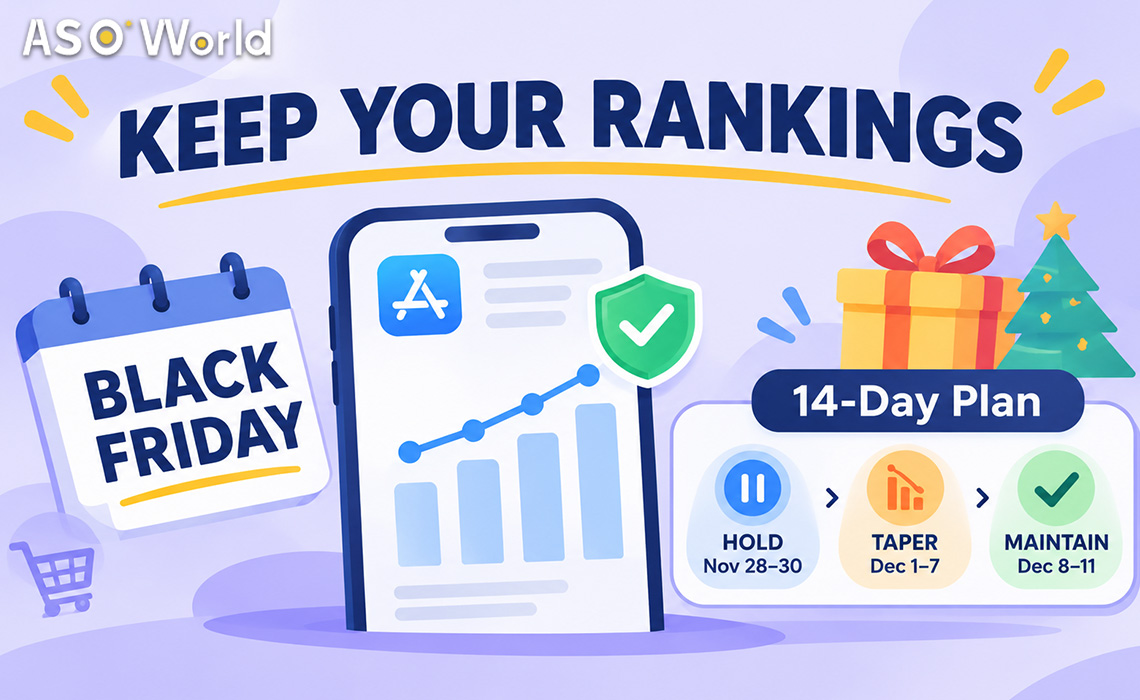
- Sort every keyword into keep, taper or drop, then follow a 14-day plan: maintain momentum through Cyber Monday (Nov 28–30), taper (Dec 1–7), then settle into maintenance and prepare for Christmas (Dec 8–11).
- A maintenance pace generally costs a fraction of your peak-week budget, while preserving positions that may become valuable again at Christmas and New Year.
- If your Black Friday spend moved your account into a higher membership tier, your December unit prices are already lower. Check your tier and remaining balance before deciding to stop.
Why do rankings fall straight after Black Friday?
| Cause | What happens | What you can control |
|---|---|---|
| Install velocity slows | Rankings, particularly chart positions, are influenced by recent installs. When your campaign or promotion ends, velocity drops and positions tend to follow | How gradually you reduce activity |
| Seasonal terms cool down | "Black friday deals", "cyber monday" and similar terms lose much of their search volume within days | Which keywords you continue to fund |
| Competitors turn to Christmas | Budgets shift towards gift, holiday and year-end search terms | Whether you've positioned yourself for those terms already |
| Store re-ranking | Some keyword positions settle lower once the seasonal spike has passed | Your maintenance pace and keyword relevance |
Only the first three are fully within your control, and managing them is enough to preserve much of what you've gained.
Stop, taper or maintain? What does each option cost?
| Option | What you do | What usually happens | When it makes sense |
|---|---|---|---|
| Stop | End every order on Nov 28 | iOS positions fade within days; Google Play rankings drift down over a week or two; chart positions disappear quickly | Seasonal-only apps, or campaigns that didn't deliver a return |
| Taper | Reduce volume in stages over 7–10 days | Some positions ease back, but core terms generally remain close to their current range | Most apps; the default approach |
| Maintain | Keep your strongest terms running at a lower, steady pace into December | Positions are sustained, ready for Christmas and New Year searches | Apps with keywords that remain relevant throughout the year |
For most teams, the best approach is to taper first, then maintain the strongest performers. Stopping saves a few days of spend, but can cost more later when you need to rebuild those same positions for Christmas.
Step 1: Review every keyword (keep, taper or drop)
Export your Black Friday keyword list and classify each term using the table below:
| Signal from the last 14 days | Decision | Next pace |
|---|---|---|
| In the Top 10, generating search installs and relevant all year | Keep | Maintenance pace |
| In the Top 10 and generating installs, but seasonal (black friday, cyber monday, deals today) | Taper → drop | Halve the volume, then stop by Dec 4 |
| Top 11–30, moving upwards and relevant all year | Keep | Maintain a moderate pace for another 1–2 weeks |
| Top 10 but no search installs | Drop | Improve the product page first; stop paying for the position |
| Still outside the Top 50 after 10+ days | Drop | Review relevance and replace with long-tail terms |
| Christmas or gift intent (gift, christmas, holiday) | Add / keep | Start or continue now; these terms peak in mid-December |
Most apps will end up with 5–10 keywords to keep, a handful to taper, and a short list to drop.
Step 2: Follow the 14-day taper plan
Days 1–3 (Nov 28–30): Maintain through Cyber Monday
- Keep keep and taper keywords at roughly their peak pace through Cyber Monday (Nov 30). Search traffic is still strong.
- If you ran a chart campaign, reduce it by around half on Nov 28 and finish by Nov 30. Chart positions tend to fade quickly regardless; tapering simply makes the decline less abrupt.
- Replace promotional text and screenshots as soon as your Black Friday offer ends. An expired promotion on the product page can undermine conversion.
Days 4–10 (Dec 1–7): Taper
- Keep keywords: reduce to around 50–60% of peak volume, then down to 30–40% by Dec 7.
- Taper keywords (seasonal): halve the volume on Dec 1 and stop by Dec 4.
- Avoid cutting every keyword on the same day. Spread reductions over several days to give rankings time to settle.
- Expect a modest dip as volume decreases. Assess performance using a 7-day average rather than a single day's figures.
Days 11–14 (Dec 8–11): Maintain and prepare for Christmas
- Keep keep keywords at a consistent maintenance pace, proportionate to your daily organic installs.
- Start or increase activity for Christmas and gift-intent keywords now. Their peak is in mid-December.
- On iOS, submit any holiday metadata updates early in December. App Store review and indexing take time, and Apple generally publishes a holiday submission timetable towards the end of the year.
You can adjust volume by keyword and country through keyword installs, from $0.20 per install on Google Play and $0.30 on iOS (checked November 10, 2026).
Step 3: How much does tapering cost compared with stopping?
Illustrative example: Google Play, 10 keywords retained in one country
| Period | Pace | Installs | Cost at $0.20 |
|---|---|---|---|
| Black Friday week (reference) | 10 keywords × 15/day × 7 days | 1,050 | $210 |
| Nov 28–30 (hold) | 10 × 15/day × 3 days | 450 | $90 |
| Dec 1–7 (taper, average ~8/day) | 10 × 8/day × 7 days | 560 | $112 |
| Dec 8–11 (maintain) | 10 × 5/day × 4 days | 200 | $40 |
| Total for the 14 days | 1,210 | $242 |
At a maintenance pace, keeping 10 keywords active costs around $10 per day in this example. Rebuilding the same positions from scratch for Christmas would generally require another full ramp-up of 1–2 weeks at a higher volume.
Unit prices also decrease as your cumulative spend reaches each membership tier. For example, Google Play keyword installs fall from $0.20 at Base to $0.19 at Bronze (from $1,000 cumulative spend) and $0.17 at Silver (from $5,000). If your Black Friday campaign moved you up a tier, your December rates are already lower.
If you'd like to run the taper and Christmas follow-up as a single campaign, the keyword ranking and organic downloads solution covers planning, pacing and reporting.
Step 4: Carry your momentum into Christmas and New Year
The weeks following Black Friday are a useful opportunity to reposition:
| Window | What users search for | What to do |
|---|---|---|
| Dec 1–15 | Gifts, holiday planning, travel and budgeting | Add gift and holiday-related keywords; refresh screenshots |
| Dec 16–25 | Last-minute gifts, new devices and games for the holidays | New-device installs peak around Christmas. Ensure your onboarding and first screenshots make a good impression on new users |
| Dec 26–Jan 7 | New Year resolutions: fitness, learning, finance and productivity | Prepare resolution-related keywords in December so they're indexed before January 1 |
If your category sees a seasonal lift (games, photo, productivity or fitness), a short category campaign around Christmas may deliver better returns than one during Black Friday week. The boost app rankings and user acquisition solution explains how to coordinate chart and keyword activity.
Step 5: Report what Black Friday actually achieved
Before setting your December budget, prepare a one-page review with five figures:
- Keywords in the Top 10 before and after the campaign.
- Search impressions (App Store Connect / Play Console), comparing campaign weeks with the preceding two weeks.
- Organic installs from search, using the same comparison.
- Product page conversion rate during the promotion.
- Cost per additional organic install: total spend ÷ additional organic installs.
These figures show which keywords and markets merit December investment, and give your team the evidence it will want to see.
Should you warn your customers or team about the dip in advance?
Yes. A planned taper usually brings a small, temporary ranking dip. If the people monitoring performance aren't expecting it, they may panic and ask you to restart the campaign at full volume, wasting budget. Share the taper timetable in advance, identify the keywords being deliberately dropped, and agree to review results using a 7-day average. One clear update can prevent most post-holiday conversations about the campaign having "stopped working".
Post-Black Friday checklist
- ☐ Every keyword classified as keep, taper, drop or add
- ☐ Chart activity reduced on Nov 28 and finished by Nov 30
- ☐ Expired promotional text and screenshots replaced
- ☐ Taper timetable set, with reductions spread across several days
- ☐ Christmas and New Year keywords selected and added to metadata
- ☐ Remaining account balance and current membership tier checked
- ☐ One-page Black Friday review shared with the team
Want the taper and holiday plan managed end to end?
The app promotion service can coordinate the post-Black Friday taper, Christmas keyword build-up and any holiday chart campaigns as one market-by-market plan. New accounts currently receive 50% off their first order, as displayed on the site (check the page for the latest terms).
FAQ
Why did my app's ranking fall after Black Friday?
Usually because install velocity declined when campaigns and promotions ended, seasonal search terms lost volume, and competitors redirected their budgets towards Christmas. Rankings influenced by recent activity tend to fall when that activity stops.
Should I stop all keyword campaigns after Black Friday?
Usually not. Stop seasonal terms, but gradually taper evergreen keywords and keep the strongest performers at a maintenance pace. Stopping everything at once can cost more in the long run, when you need to rebuild for Christmas.
How long should the taper last?
Around 7–10 days. Maintain activity through Cyber Monday, then reduce volume in stages during the first week of December.
How much does it cost to maintain keyword rankings?
At a maintenance pace, it is often a fraction of peak spend. In the example above, around $10 per day maintains 10 Google Play keywords in one country. Actual requirements depend on competition and your organic installs.
When should I start Christmas ASO?
In early December. Add gift and holiday keywords during the first week, and submit iOS metadata updates early enough to allow for review and indexing before the year-end slowdown.
What should I report after Black Friday?
The number of Top 10 keywords before and after the campaign, search impressions, organic search installs, product page conversion rate, and cost per additional organic install.